

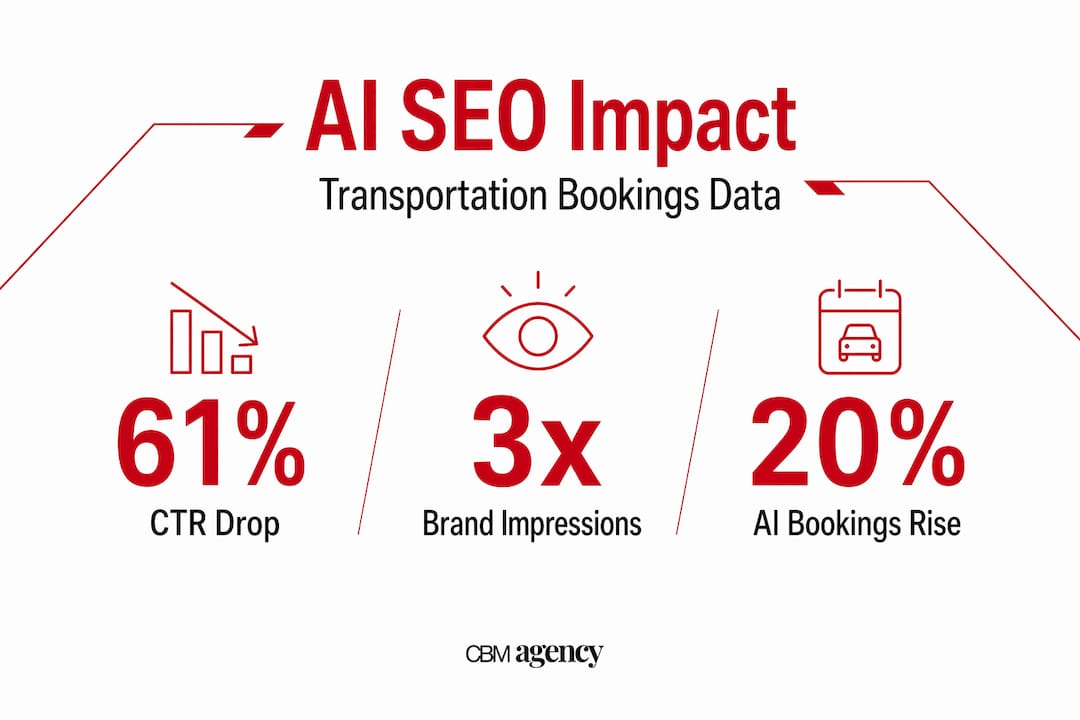
Google changed the rules, and most transportation businesses haven't noticed yet. The role of AI in SEO is no longer a future concern — it's reshaping how customers find limo services, charter companies, and logistics providers right now. When Google displays an AI Overview, organic CTR drops from 1.76% to 0.61%, a 61% reduction. That means the strategies that filled your booking calendar two years ago are delivering less than half the traffic today. This guide breaks down exactly what's changing, why it matters for transportation companies in the U.S. and Caribbean, and what you can do about it.
Table of Contents
- How AI reshapes SEO in transportation and logistics
- Understanding AI-driven SEO mechanics for transportation businesses
- Comparing traditional SEO and AI-optimized SEO strategies
- Practical AI SEO tactics for transportation businesses
- Why embracing AI-driven SEO is a competitive advantage for transportation businesses
- Leverage CBM Agency's AI-powered SEO services for transportation businesses
- Frequently asked questions
Key Takeaways
| Point | Details |
|---|---|
| AI reduces traditional clicks | Google AI Overviews lower organic click-through rates significantly by providing direct answers. |
| Structured content wins | Using schemas like FAQPage helps transportation sites get cited in AI-generated summaries. |
| Brand authority matters | Strong, authoritative brand signals increase chances of AI citation and improved visibility. |
| Human expertise is essential | Combining AI tools with expert review maintains authentic brand voice and content quality. |
| Focus shifts to citations | SEO success now includes visibility in AI answers, not just website traffic and rankings. |
How AI reshapes SEO in transportation and logistics
Search is no longer a list of blue links. Google now generates AI Overviews — direct, paragraph-style answers pulled from trusted sources — and they appear at the very top of the results page. AI Overviews appear on 30-40% of all Google searches as of 2026. If someone searches "best airport transfer service in Miami" or "how much does a charter bus cost in the Caribbean," Google may answer that question before a single website link appears.
For transportation companies, this creates a specific problem. Informational pages — your FAQ pages, pricing guides, route explainers — used to pull steady traffic. Now they're being summarized by AI, and organic traffic dropped 20-40% on informational content across many industries. Your fleet stays parked not because demand dropped, but because the search engine answered the question before the customer reached your site.
The shift also changes what "winning" looks like. Traditional SEO meant ranking on page one. AI-driven SEO means being the source Google cites inside its generated answer. That's a fundamentally different goal. To master AI SEO optimization, you need to understand what AI looks for when it decides who to trust.
Here's what AI-driven search now prioritizes for transportation businesses:
- Conversational, intent-focused content that answers full questions, not just keyword phrases
- Structured data that helps AI extract and verify your information quickly
- Topical depth across related subjects, not just one optimized page
- Consistent entity signals — your business name, location, and service area appearing accurately across the web
- Authoritative sourcing that signals your content is reliable enough to cite
Understanding AI search behaviors in local business is the first step toward adapting your digital presence to capture this new kind of visibility.
Understanding AI-driven SEO mechanics for transportation businesses
So how does AI actually decide which transportation company to feature in an Overview? It comes down to three things: structured data, topical authority, and entity recognition. Let's break each one down.

AI shifts SEO from indexing and ranking to synthesis and citations, with visibility measured by presence in AI-generated answers rather than clicks. That means your content needs to be machine-readable, not just human-readable.
Here's how to build that foundation:
-
Add FAQPage schema to every service page. Schema markup is code added to your website that tells search engines exactly what your content means. Pages with FAQPage schema appear in AI Overviews 3.2 times more often than pages without it. For a limo company, that means a page titled "Airport Transfers in Fort Lauderdale" should include 5-8 structured Q&As covering pricing, pickup process, vehicle types, and cancellation policy.
-
Build topical clusters, not isolated pages. One page about "charter bus rentals" isn't enough. You need supporting content around related topics — group travel logistics, school trip transportation, corporate shuttle services, and vehicle capacity guides. This signals to AI that your site is an authority on the subject, not just a landing page.
-
Claim and reinforce your entity. An "entity" in SEO terms is your business as a recognized, verifiable subject — like a Wikipedia entry but built through consistent mentions across Google Business Profile, directories, press mentions, and structured data. The more consistently your business name, address, phone number, and service area appear across the web, the stronger your entity signal.
-
Use HowTo schema for process-based content. If you explain how to book a private transfer or what to expect on a Caribbean charter, HowTo markup helps AI extract that step-by-step information and cite it directly.
Pro Tip: Building AI search visibility with schema doesn't require a developer for every update. Tools like Google's Rich Results Test let you verify your schema is working before you publish. Check it every time you add a new service page.
Transparency also matters. AI algorithms favor content that clearly identifies who wrote it, what their expertise is, and when it was last updated. Add author bios, publication dates, and review dates to every page. It's a small change that sends a strong trust signal. For more on ranking on AI search engines, the technical foundation starts here.
Comparing traditional SEO and AI-optimized SEO strategies
The difference between old-school SEO and AI-optimized SEO isn't subtle. It's a complete reframing of what success means. Here's a direct comparison:
| Factor | Traditional SEO | AI-optimized SEO |
|---|---|---|
| Primary goal | Rank on page one | Be cited in AI Overviews |
| Success metric | Click-through rate | Citation frequency and brand impressions |
| Content format | Keyword-dense pages | Structured, conversational, schema-marked content |
| Link strategy | Backlinks for authority | Entity signals and topical depth |
| Traffic type | High volume, broad | Lower volume, higher intent |
| Update frequency | Quarterly or annual | Every 60-90 days minimum |
| Local focus | City-targeted keywords | Location entities and proximity signals |
The numbers tell the story clearly. CTR fell 61% on queries with AI Overviews, but brand impression volume increased through direct navigation. That means fewer people click from Google, but more people who already know your brand go directly to your site. The goal shifts from attracting strangers to becoming the recognized name in your market.
For transportation businesses, this matters because your customers often search with high intent. "Book airport transfer Nassau Bahamas" or "corporate car service Miami" are transactional queries. AI Overviews are less likely to fully replace those clicks. But informational queries — "how much does a limo cost for prom" or "what's the difference between a charter bus and a shuttle" — are exactly where AI steps in and absorbs the traffic.
The smart play is to protect your transactional pages with the latest SEO best practices while restructuring your informational content to earn AI citations instead of just clicks.
Key differences to act on now:
- Stop measuring only rankings. Track AI citation presence, branded search volume, and direct traffic alongside traditional metrics.
- Prioritize depth over breadth. One thorough, well-structured page outperforms five thin ones.
- Write for the question, not the keyword. AI reads intent, not just phrasing.
Practical AI SEO tactics for transportation businesses
Knowing the theory is one thing. Here's what to actually do, starting this week.
-
Audit your robots.txt file. Make sure you're not accidentally blocking Google-Extended, the bot that feeds AI Overviews. If Google-Extended can't crawl your site, you won't appear in AI-generated answers, period. This is a five-minute fix with a major impact.
-
Build local content clusters. Transportation businesses should create local content clusters with FAQPage schema, updating pages regularly for AI Overview advantage. For a Miami-based limo company, that means separate, detailed pages for airport transfers, corporate accounts, wedding transportation, and cruise port pickups — each with its own FAQ section and schema markup.
-
Update your content every 90 days. AI systems favor freshness. A page last updated in 2023 sends a weak signal. Add new Q&As, update pricing notes, and refresh statistics. Even small edits signal that your content is current and maintained.
-
Fix your Core Web Vitals. Page speed and load stability aren't just ranking factors — they're trust signals. A slow site tells AI (and users) that your business isn't keeping up. Use Google Search Console to identify and fix issues.
-
Write FAQ sections for every service page. Each FAQ should have 5-10 questions written the way a real customer would ask them. "What vehicles do you have for airport transfers in San Juan?" beats "Vehicle options." Natural language matches how AI processes queries.
Pro Tip: Check your top AI SEO tools for transportation to automate content gap analysis. These tools identify which questions your competitors are answering that you're not, so you can fill those gaps with targeted, schema-marked content.
Why embracing AI-driven SEO is a competitive advantage for transportation businesses
Here's the take most articles won't give you: the transportation companies that are panicking about AI search are the ones with weak content to begin with. AI didn't create a new problem. It exposed an old one.
The margin for mediocrity has never been wider; AI favors quality with genuine expertise over generic content. If your website has five pages of vague service descriptions and no real information about your routes, your vehicles, or your team's experience, AI will skip you. But if you've built real content that reflects real operational knowledge, AI will cite you — and your competitors who haven't done the work will lose ground.
Transportation is one of the few industries where authentic human expertise genuinely differentiates content. You know things about navigating Miami International Airport's pickup zones, managing group logistics in the Caribbean, or handling last-minute corporate requests that no generic AI-generated page can replicate. That knowledge, structured properly and published consistently, is your competitive moat.
The businesses winning in AI search right now aren't the ones with the biggest budgets. They're the ones with the clearest brand voice, the most organized content, and the strongest entity presence. The private chauffeur SEO lessons from companies that made this shift early are clear: specificity beats volume, and authority beats volume every time.
Stop treating your website like a brochure. Build it like a booking engine that also happens to be the most trusted source of transportation information in your market. That's what AI rewards.
Leverage CBM Agency's AI-powered SEO services for transportation businesses
Transportation businesses across the U.S. and Caribbean are navigating this AI search shift right now, and the gap between those adapting and those waiting is growing fast.
CBM Agency works exclusively with transportation and service businesses to build Google visibility, local SEO strength, and AI citation presence that turns searches into calls and bookings. From Google Business Profile services that put your company on the map to schema implementation and content clustering, every strategy is built for your industry. You can see the results directly in our Google Maps case study. And if you're ready to build a presence that shows up in AI-generated answers, our AI search visibility optimization service is where to start. Your competitors are moving. Let's make sure you're ahead of them.
Frequently asked questions
What is the role of AI in modern SEO for transportation businesses?
AI shifts SEO focus from traditional rankings to being featured in AI-generated answers and citations, requiring structured and authoritative content to maintain visibility. AI moves SEO from indexing to synthesis, so your content must be organized for machines to extract and trust.
How can transportation companies optimize content for AI Overviews?
Implement FAQPage schema with 5-10 concise Q&As, update pages at least every 90 days, and structure content around real customer questions. Pages with FAQPage schema appear 3.2 times more often in AI Overviews than unstructured pages.
Why are click-through rates lower with AI-driven search results?
AI Overviews answer questions directly on the search page, so users get the information they need without clicking through to a website. Organic CTR drops to 0.61% when an AI Overview appears, compared to 1.76% without one.
Does AI-generated content replace human expertise in SEO?
No. AI helps with research and drafting, but your brand voice, operational knowledge, and editorial judgment are what make content worth citing. AI struggles with brand voice and emotional intelligence, making human oversight essential for quality SEO content.
How should transportation businesses measure SEO success in the AI era?
Track AI citation frequency, branded search volume, and direct traffic alongside traditional click and ranking metrics. Traffic volume is giving way to AI citation frequency and brand entity strength as the real measures of search success.