

Most transportation businesses treat SEO as a keyword game. Get the right words on the page, rank higher, done. That thinking is exactly why their fleet stays parked while competitors get the calls. Understanding what is SEO best practices today means going far beyond keywords. It means building a web presence that genuinely answers what your customers are searching for at the exact moment they are ready to book. This guide gives you a clear, practical roadmap specifically built for transportation businesses in the U.S. and Caribbean who want more visibility, more calls, and more bookings from Google.
Table of Contents
- Understanding SEO and why best practices matter for transportation businesses
- Local SEO best practices: Boosting calls and bookings through Google Business Profile and location targeting
- Technical SEO essentials and content optimization for competitive transportation markets
- Converting local searchers into customers: Conversion-focused SEO best practices for transportation businesses
- Why many transportation businesses struggle with SEO — and how to fix it
- How CBM Agency helps transportation businesses master SEO and increase calls
- Frequently asked questions
Key Takeaways
| Point | Details |
|---|---|
| Align content with search intent | Create genuinely useful, targeted content that satisfies what transportation customers seek in their search queries. |
| Leverage local SEO | Optimize your Google Business Profile and build location-specific service pages to maximize visibility and calls in your service areas. |
| Meet technical standards | Ensure your website meets Google’s technical requirements to enable proper crawlability and indexing for ranking eligibility. |
| Focus on conversion | Design pages with pricing, process info, proof, FAQs, and strong CTAs that reduce hesitation and drive bookings. |
| Maintain consistency and trust | Regularly earn and respond to reviews and keep your business information consistent across the web to build prominence and user confidence. |
Understanding SEO and why best practices matter for transportation businesses
SEO stands for Search Engine Optimization. In plain terms, it is the practice of improving your website and online presence so Google shows your business to people actively searching for your services. But ranking on Google is not just about stuffing the right words onto a page. It requires meeting technical standards, building authority, and creating content people actually find useful.
There are three major types of SEO you need to understand:
- On-page SEO: The content, headings, keywords, and structure on your website pages
- Off-page SEO: External signals like backlinks, citations, and your Google Business Profile (GBP), which is the listing that appears on Google Maps and local search results
- Technical SEO: The behind-the-scenes factors that allow Google to find, read, and index your site, including page speed, mobile usability, and site structure
SEO best practices center on aligning content to search intent, creating genuinely useful content, and maintaining strong page fundamentals. Search intent means understanding why someone is searching, not just what they typed. A person searching "airport transfer Miami" is ready to book, not browsing. Your page needs to speak to that moment.
For a transportation business, good SEO translates directly into phone calls and booking requests. Every ranking you earn is a chance to put a customer in one of your vehicles.
The difference between businesses that get consistent leads from Google and those that do not usually comes down to one thing: whether they treat SEO as an ongoing practice or a one-time task. Getting a solid grasp of the SEO best practices overview early saves you from chasing shortcuts that never deliver lasting results.
Having defined SEO and its importance, we now explore how these best practices specifically apply to transportation businesses seeking local leads.
Local SEO best practices: Boosting calls and bookings through Google Business Profile and location targeting
Local SEO is Google's front door for service businesses. When someone in your city searches "limousine service near me" or "cargo transport Port of Miami," Google shows a map pack with three local listings before any regular website results. Getting into that map pack is where your calls come from.

The fastest SEO lane for service businesses is Local SEO, through Google Business Profile optimization, consistent NAP (Name, Address, Phone number), reviews, and targeted location pages. Here is how to execute each piece:
Step-by-step local SEO foundation:
- Complete your Google Business Profile fully. That means selecting the right primary category (such as "Transportation Service" or "Limousine Service"), adding all service types, uploading real photos of your vehicles and team, and writing a clear business description with your main service and location.
- Keep your NAP consistent everywhere. Your business name, address, and phone number must appear identically on your website, GBP, Yelp, Apple Maps, and every directory where your business is listed. Even small discrepancies like "St." vs. "Street" can confuse Google and dilute your local trust signals.
- Build a review acquisition system. After every completed trip or delivery, ask for a Google review. Make it easy by sending a direct link. Aim for a minimum of 10 new reviews per month. Respond to every review, positive or negative, within 48 hours.
- Create dedicated location pages. If you serve Miami, San Juan, Kingston, and Nassau, each city deserves its own page. Not a copy-paste job with the city name swapped. Real content that mentions local landmarks, airports, ports, and specific services you offer there.
- Use local keywords naturally. Phrases like "Miami airport car service" or "Caribbean freight transport" should appear in your page titles, headings, and body text without forcing them.
Look at how location pages in logistics can be structured to demonstrate geographic service coverage clearly. This kind of dedicated page architecture tells Google exactly where you operate and who you serve.
Local SEO ranking factors for transportation businesses:
| Factor | Impact level | Action needed |
|---|---|---|
| GBP completeness | Very high | Fill every field, add photos weekly |
| NAP consistency | High | Audit all directories quarterly |
| Review volume and recency | High | Request reviews after every job |
| Location page quality | High | One detailed page per service area |
| Local keyword relevance | Medium | Use naturally in content and titles |
Pro Tip: Optimizing your Google Business Profile is not a one-time task. Post updates weekly, add new photos monthly, and update your hours for holidays. Google rewards active profiles with higher visibility in the local pack.
Pairing strong GBP management with local SEO content strategies creates a compounding effect. Each piece of location-specific content reinforces your geographic relevance, making your business harder to outrank.
With local SEO fundamentals clear, let's examine the technical and content requirements that ensure these efforts are recognized and rewarded by Google.
Technical SEO essentials and content optimization for competitive transportation markets
You can have the best content in your market, and none of it matters if Google cannot access your site. Technical SEO is the foundation everything else sits on. Sites must meet Google Search Essentials technical requirements, avoid spam policies, and use Search Console for indexing health to be eligible to rank in Google.
Here are the non-negotiable technical standards your transportation website must meet:
- Crawlability: Google's bots must be able to access all your key pages. Avoid blocking important pages in your robots.txt file and keep your internal linking clean so bots can navigate easily.
- Google Search Console: This is Google's free tool for monitoring your site's indexing health. Submit your sitemap here and check it weekly for crawl errors or pages that have dropped out of the index.
- Mobile-first performance: Google ranks the mobile version of your site first. If your booking form is broken on a phone, you are losing leads directly. Test your site on multiple devices and aim for a page load time under three seconds.
- Schema markup: This is structured data code added to your pages that helps Google display enhanced results, such as your star rating, phone number, or service area, directly in the search results. Local Business schema and Service schema are the most valuable for transportation companies.
- Core Web Vitals: Google measures page experience through metrics like loading speed, visual stability, and interactivity. Poor scores here hurt rankings and drive visitors away before they can book.
Technical SEO priority table for transportation websites:
| Technical element | Why it matters | Tool to check it |
|---|---|---|
| XML sitemap | Helps Google find all your pages | Google Search Console |
| Page speed | Affects rankings and bounce rate | Google PageSpeed Insights |
| Mobile usability | Google indexes mobile version first | Search Console Mobile Report |
| Schema markup | Enhances local search results | Google Rich Results Test |
| HTTPS/SSL | Trust signal for users and Google | Browser address bar check |
Content matters just as much as the technical side. Transportation buyers search with very specific questions: "How much does a charter bus cost in Orlando?" or "What is the transit time for cargo from Miami to Puerto Rico?" Your service pages need to answer those questions directly.
Pro Tip: Pages that address decision-stage questions about pricing ranges, coverage areas, and booking processes consistently outperform generic "about us" content for generating actual calls. A pricing page that says "Our airport transfers start at $75" does more conversion work than a page that says "We offer competitive rates."
Building out your technical SEO basics in parallel with your content work is the right sequence. Get the foundation solid, then layer on content that answers what your buyers are actually asking.
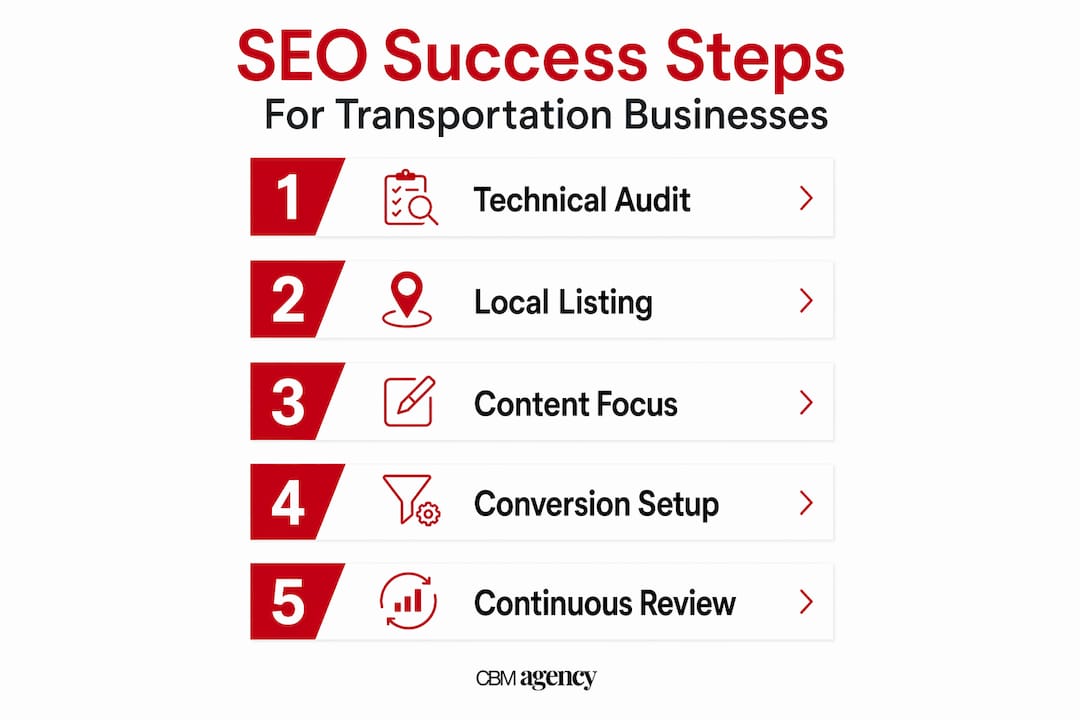
Having covered the technical and content foundations, we now discuss advanced approaches to convert traffic into tangible calls and bookings.
Converting local searchers into customers: Conversion-focused SEO best practices for transportation businesses
Ranking on Google gets you in front of the right people. What happens next determines whether they call or leave. Lead conversion depends on minimizing search-to-contact friction via detailed pricing, step-by-step process, proof of credibility, FAQs, and strong calls-to-action on service and location pages.
Here is what your service pages and GBP need to turn a visitor into a booking:
- Pricing context: You do not have to publish exact rates, but giving a starting range removes the biggest hesitation most transportation buyers have. "Airport transfers starting at $65" or "Freight quotes provided within 2 hours" sets expectations and builds trust.
- Your process explained: Walk visitors through exactly what happens after they contact you. Do they get a quote within one hour? A confirmation email? A driver update before pickup? Spelling this out reduces anxiety and increases conversions.
- Proof near your CTAs: Place your review rating, license numbers, and any fleet certifications directly next to your booking button or phone number. Trust signals work best when they are physically close to the action you want visitors to take.
- FAQ section on every service page: Address the questions your customers ask before booking. Common examples for transportation businesses include "Do you track flights for airport pickups?", "Are your drivers background-checked?", and "What is your cancellation policy?"
- Clear, visible CTAs: Your phone number should be clickable on mobile and visible without scrolling on every page. "Book Now" buttons should appear above the fold and at the bottom of every service description.
Conversion page elements: comparison
| Page element | Without it | With it |
|---|---|---|
| Pricing range | High bounce, low contact | More qualified calls |
| Service process | Visitor uncertainty | Confidence to book |
| Reviews near CTA | Trust gap at decision point | Higher conversion rate |
| FAQ section | Pre-sale objections unresolved | Faster booking decisions |
| Mobile click-to-call | Calls lost on mobile | Direct phone conversions |
Pro Tip: AI-driven local search is increasingly surfacing businesses that have detailed, well-structured pages over those with thin content. Writing clearly for people also writes clearly for AI-powered search tools. These are not competing goals.
Your Google Business Profile conversion strategy also plays a direct role here. Businesses that use GBP posts to share offers, feature services, and answer common questions give searchers a reason to call before they even reach your website.
With clear conversion tactics in place, let's reflect on the unique insights and challenges transportation businesses face in applying SEO best practices.
Why many transportation businesses struggle with SEO — and how to fix it
Here is the honest truth most SEO content will not tell you: ranking higher on Google will not fix a broken conversion path. We see transportation businesses invest in getting to page one, then wonder why the calls have not increased. The problem is almost never the ranking. It is what happens when someone lands on the page.
The second major mistake is treating SEO as a project with a finish line. You build out your GBP, publish a few location pages, and wait. But local SEO rewards businesses that operate with clarity, consistency, and responsiveness rather than shortcuts or one-time setups. Your competitors are asking for reviews every week. If you are not, you are falling behind even while you sleep.
Broad geographic claims are another trap. Transportation businesses sometimes list every city within 200 miles hoping to capture more searches. But claiming service in locations you cannot reliably serve, or building thin pages for areas without real operations, sends weak signals to Google and disappoints the customers who do call. Specificity beats breadth. A single well-built page for one city you genuinely serve will outperform ten thin pages scattered across a region.
Review generation is the one task most businesses know they should be doing consistently and almost none actually do. Reviews build local prominence. They also reduce the hesitation of every new customer reading your profile. One review request system, sent after every completed job, compounds over months into a competitive advantage that is genuinely hard to replicate quickly.
The businesses we see break through consistently are the ones who understand that avoiding common SEO pitfalls is not about advanced tactics. It is about disciplined execution of the fundamentals, repeated week after week. Better content. More reviews. Faster pages. Cleaner location targeting. None of it is complicated. Most of it just requires showing up consistently.
How CBM Agency helps transportation businesses master SEO and increase calls
If you recognize any of the challenges described in this article, you are not alone. Most transportation businesses we work with come to us after trying to manage SEO on their own and not seeing the results they expected.
CBM Agency works specifically with transportation and service businesses across the U.S. and Caribbean. We handle Google Business Profile optimization from initial setup to ongoing management, build location-specific content that ranks and converts, and apply technical SEO standards that keep your site in good standing with Google. Our work is built around one goal: turning more of your Google visibility into actual calls and bookings. You can explore a real Google Maps visibility case study to see what consistent, targeted local SEO produces for businesses like yours. When you are ready to stop guessing and start growing, our local marketing services are built to deliver exactly that.
Frequently asked questions
What are SEO best practices for transportation businesses?
SEO best practices for transportation businesses include optimizing Google Business Profiles, maintaining consistent contact details across all directories, earning and responding to customer reviews, building location-specific service pages with clear calls to action, and meeting technical SEO standards for crawlability and indexing.
How does Google Business Profile impact my local SEO?
A complete and accurate Google Business Profile improves local rankings because complete business information directly improves local ranking by matching profiles to relevant searches, making it easier for customers to find and contact your business directly.
Why is technical SEO important for transportation websites?
Technical SEO ensures Google can access, crawl, and index your website pages properly, and sites must meet Google Search Essentials technical requirements for crawlability to be eligible to rank in search results.
What kind of content converts best for transportation businesses?
Content that directly answers decision-stage questions about pricing, coverage, timelines, and booking processes converts best, because transportation content addressing availability, lanes, timelines, and requirements outperforms purely informational topics in generating actual calls and bookings.