

Most transportation businesses are leaving serious money on the table. You're running a solid operation, your drivers are professional, and your vehicles are spotless. But when a potential client in your city searches "airport car service near me" or "corporate transportation company," your business doesn't show up. Your competitor does. The gap between you and them isn't the quality of service. It's SEO strategy. A well-built SEO strategy turns your website into a booking engine, not a brochure, and it pulls in local customers who are already ready to hire.
Table of Contents
- What is SEO strategy and why does it matter?
- Core components of an effective SEO strategy
- Local SEO: The powerhouse for transportation businesses
- AI, automation, and the evolving SEO landscape
- Building your own SEO strategy: Transportation business checklist
- What most transportation businesses get wrong about SEO strategy
- Ready to amplify your online presence?
- Frequently asked questions
Key Takeaways
| Point | Details |
|---|---|
| SEO is a strategy, not a set of tricks | Lasting growth requires combining technical, content, and local tactics. |
| Local SEO drives fast results | Optimizing Google Business Profile and reviews generates quick leads. |
| AI tools boost your efforts | Smart automation makes SEO more efficient and impactful. |
| Integrated approach wins | Technical fixes, content, and reviews together outperform any single tactic. |
| Track, adapt, and win | Regularly monitoring results and adjusting your strategy brings ongoing success. |
What is SEO strategy and why does it matter?
Let's cut through the confusion first. SEO strategy is not just stuffing keywords into your website copy. It's a structured, ongoing plan to improve where your business appears in Google and local search results, so the right customers find you at the right moment.
An SEO strategy combines technical, content, and local ranking tactics into one coordinated system. Think of it like maintaining a fleet. You don't just change the oil and ignore the tires. Every component has to work together or the whole thing breaks down.
For transportation businesses specifically, SEO strategy covers several key areas:
- Technical health: Is your website fast, mobile-friendly, and free of broken links?
- Content quality: Do your pages answer the questions your customers are actually asking?
- Local signals: Are you showing up in Google Maps and the local search pack?
- Trust factors: Do you have consistent reviews, citations, and a complete Google Business Profile?
Here's what makes transportation SEO different from other industries. Your customers are often searching with high intent and urgency. Someone who types "limo service Miami tonight" is ready to book, not browse. That means your visibility in local search results directly translates to phone calls and reservations.
"Most transportation companies rely on word of mouth or repeat clients. That's a great foundation, but it's not a growth strategy. The businesses pulling ahead are the ones showing up in search before a customer even thinks to ask for a referral."
Unlike one-off tactics like running a Google ad for a week, a true SEO strategy builds compounding results over time. Every optimized page, every earned review, and every technical fix adds to your overall authority. Start by optimizing your Google Business Profile as your first concrete step, because that's where local searches convert fastest.
Pro Tip: Don't treat SEO as a project with a finish line. Treat it like customer service. It requires consistent attention to keep delivering results.
Now that we've set the foundation, let's explore the essential building blocks every transportation business should prioritize.
Core components of an effective SEO strategy
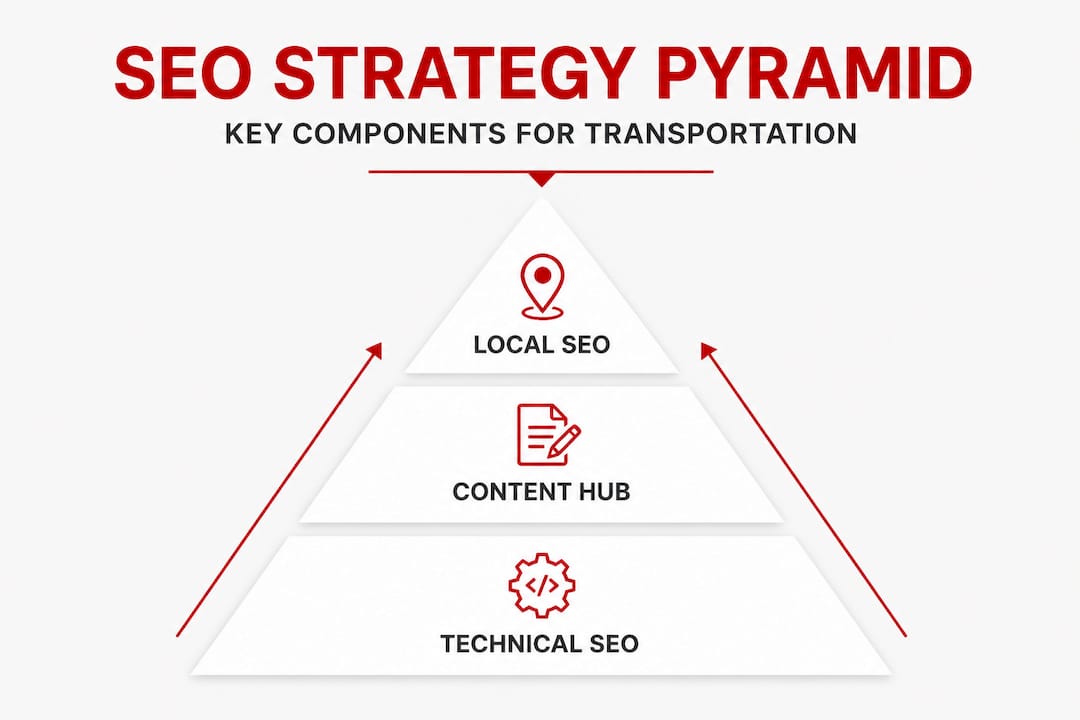
SEO for transportation is not one-size-fits-all. An integrated approach combining technical, local, and content elements consistently outperforms any single tactic used in isolation. Here's how each component contributes to your lead generation:
| SEO Component | Primary Benefit | Impact on Transportation |
|---|---|---|
| Technical SEO | Faster load times, mobile usability | Reduces bounce rate, improves rankings |
| Local/GBP Optimization | Appears in map pack | Drives direct calls and bookings |
| Content Strategy | Builds topical authority | Attracts service-area and fleet searches |
| Review Management | Builds trust and ranking signals | Converts searchers into paying clients |
Technical SEO is the foundation. If your site loads slowly on a phone, Google penalizes your ranking and customers leave before they ever see your services. Pages should load in under three seconds on mobile. Broken links, duplicate pages, and missing meta descriptions all quietly hurt your visibility.
Content clusters are one of the most powerful tools available. Instead of having one generic "services" page, build individual pages for each service type (airport transfers, corporate accounts, event transportation) and each service area you cover. This tells Google that you're an authority on these specific topics, not just a generic result.
Google Business Profile (GBP) is your front door in local search. When someone searches for transportation services near them, Google shows a map pack of three businesses before any website results. If you're not in that pack, you're invisible to a massive portion of ready-to-hire customers.

Reviews are both a trust signal and a ranking factor. The quantity, quality, and recency of your reviews all influence where you appear in local results. Responding to reviews, even negative ones, signals to Google that you're an active and engaged business.
Explore how AI SEO strategies for transportation are reshaping what it takes to rank in 2026, and understand the importance of ranking on AI search engines as these platforms become a primary discovery channel.
Pro Tip: Audit your website for broken links and page speed every quarter. These small technical issues accumulate and quietly drag down your rankings without any obvious warning signs.
Understanding the main components sets up our next step: customizing these tactics for maximum local impact.
Local SEO: The powerhouse for transportation businesses
Local SEO is where transportation companies win or lose the most business. GBP and client reviews are crucial for generating immediate local leads, and the gap between an optimized and a neglected profile is significant.
| Factor | GBP-Optimized Company | Non-Optimized Company |
|---|---|---|
| Monthly profile views | 800+ | Under 100 |
| Direct calls from Google | 60+ per month | Fewer than 10 |
| Booking inquiries | High conversion rate | Low to none |
| Map pack appearance | Consistent | Rare or absent |
The numbers tell a clear story. A fully optimized profile doesn't just look better. It performs better in every measurable way.
Here's how to maximize your Google Business Profile step by step:
- Claim and verify your profile if you haven't already. An unverified listing is an invisible one.
- Complete every field including business hours, service areas, vehicle types, and a detailed business description using relevant local keywords.
- Upload high-quality photos of your vehicles, drivers in uniform, and any amenities you offer. Profiles with photos receive significantly more engagement.
- Post weekly updates about promotions, new service areas, or seasonal offerings. Active profiles rank higher.
- Request reviews consistently from every satisfied client. Make it easy by sending a direct link to your review page after each completed booking.
- Respond to every review within 48 hours. Thank positive reviewers by name and address concerns in negative ones professionally and calmly.
- Use the Q&A section to answer common questions about your fleet, pricing, and service areas before customers even have to ask.
Learn how chauffeur companies boost bookings through smart GBP management, and stay informed about changing AI search behaviors that are already shifting how your customers discover local services.
Pro Tip: Monitor and respond to all reviews, not just the five-star ones. Google rewards active engagement, and potential clients read how you handle criticism before they decide to call.
With local foundations established, businesses can boost visibility further by embracing the latest AI and automation trends.
AI, automation, and the evolving SEO landscape
The rules of search are changing faster than most business owners realize. AI-powered search tools like Google's Search Generative Experience and third-party platforms now rank businesses based not just on keywords but on content quality, relevance, and topical authority. If your website only has thin, generic pages, you're falling behind.
Content clusters and AI-powered tools are rapidly outpacing outdated keyword tricks. What worked in 2019 won't carry you through 2026. The businesses that adapt are the ones that will dominate their local markets.
Here's what AI-driven SEO looks like in practice for transportation companies:
- Automated keyword tracking that monitors where you rank for dozens of search terms without manual checking
- Competitor gap analysis that shows you exactly which keywords your rivals rank for that you don't
- Content optimization tools that score your pages against top-ranking competitors and suggest specific improvements
- Review monitoring that alerts you whenever a new review appears across Google, Yelp, and other platforms
- Local citation management that ensures your business name, address, and phone number are consistent everywhere online
- AI-generated content drafts for service area pages, FAQ sections, and blog posts that you then refine with your own expertise and voice
Statistic callout: Studies indicate that over 58% of local business searches now involve some form of AI-powered suggestion or generative answer, meaning your content needs to be structured in a way that AI systems can read, trust, and cite.
The key is balance. Automation handles the repetitive, data-heavy tasks so you can focus on the human elements: building relationships, responding to clients, and making strategic decisions. Don't let automation make your brand sound generic. Your voice, your specific service details, and your local knowledge are competitive advantages no algorithm can replicate.
Explore the top AI SEO tools built for businesses like yours, and learn the principles behind creating AI-first content that ranks in both traditional Google results and AI-generated answers.
Pro Tip: Combine AI tools with human insights. Use automation to gather data and flag opportunities, then apply your industry knowledge to make the final call on strategy and messaging.
We've covered the ingredients. Now let's see how a combined approach leads to real-world success.
Building your own SEO strategy: Transportation business checklist
The most successful transportation firms integrate technical, local, and content tactics with review management into one consistent system. Here's your practical starting point:
- Set clear goals. Define what success looks like. More calls? More airport transfer bookings? More corporate accounts? Your goals shape your strategy.
- Audit your current website. Check page speed, mobile usability, broken links, and missing meta descriptions. Fix the technical issues first.
- Claim and fully optimize your GBP. Follow the seven-step process outlined in the previous section.
- Build service-specific pages. Create individual pages for each service type and location you serve. Each page should target specific search terms your customers use.
- Launch a review collection system. After every completed booking, send a follow-up message with a direct link to leave a Google review.
- Publish content regularly. A monthly blog post or updated FAQ page keeps your site fresh and builds topical authority over time.
- Track your rankings and leads. Use Google Search Console and Google Analytics to monitor what's working and where to improve.
- Review and adjust quarterly. SEO is not static. Revisit your strategy every three months and update based on what the data shows.
Common pitfalls to avoid:
- Ignoring mobile users. Over 70% of local searches happen on phones. A desktop-only experience costs you bookings.
- Inconsistent business information. If your phone number or address differs across directories, Google loses trust in your listing.
- Buying fake reviews. This violates Google's policies and can get your profile suspended entirely.
- Publishing thin content. A 150-word service page tells Google almost nothing. Aim for thorough, useful pages that genuinely help customers decide.
- Setting it and forgetting it. SEO requires ongoing attention. A strategy you built two years ago and never updated is likely hurting more than helping.
Visit our SEO and marketing tips resource hub for more in-depth guides tailored specifically to transportation and chauffeur businesses.
Before wrapping up, it's worth addressing some real-world lessons from years in the field.
What most transportation businesses get wrong about SEO strategy
Here's the uncomfortable truth we see repeatedly. Transportation business owners tend to fall into one of two camps. Either they obsess over getting reviews and ignore the technical and content side entirely, or they invest heavily in website design and technical fixes while neglecting their Google Business Profile and local presence. Neither approach works well on its own.
The businesses that plateau are usually the ones chasing a single silver bullet. They hear that reviews matter, so they focus only on reviews for six months. Then they hear that blogging helps, so they write three posts and stop. Real, lasting growth comes from running all the systems simultaneously, even at a modest level of effort.
What surprises most of our clients is how quickly local SEO results can appear when everything works together. Technical fixes allow your content to rank. Quality content convinces GBP visitors to call. Fresh reviews push your profile higher in the map pack. Each element amplifies the others. That's the compounding effect of an integrated strategy, and it's why businesses with smaller budgets can outperform larger competitors who are only doing one thing well.
We've seen transportation companies go from page three obscurity to the top of the local map pack within three to four months, not because they did anything dramatic, but because they were consistent and covered all the bases. Learn more about our SEO experience and the results we've helped transportation businesses achieve.
The other mistake is relying on assumptions instead of data. If you don't know which pages bring in traffic, which keywords you rank for, or how many calls come from your GBP, you're flying blind. Analytics aren't optional. They're how you stop guessing and start growing.
Pro Tip: Track what works by reviewing your Google Search Console and GBP insights monthly. The data will show you exactly where to focus your next effort.
Ready to amplify your online presence?
Your competitors are not waiting. Every month without a solid SEO strategy is another month your fleet stays parked while their phones ring.
At CBM Agency, we specialize in helping transportation businesses improve their Google visibility, dominate local search, and build authority in AI-powered search results. Whether you need to see what's possible through our Google Maps case study or you're ready to take action with Google Business Profile optimization, we have the tools and experience to move the needle fast. We also offer AI search visibility services built specifically for businesses that want to stay ahead as search continues to evolve. Let's turn more searches into real bookings.
Frequently asked questions
What are the first steps to build an SEO strategy for a transportation company?
Start with a fully completed Google Business Profile, gather recent client reviews, optimize your key website pages for local keywords, and create content targeting your specific service areas. GBP and reviews are foundational for generating local SEO leads quickly.
How long does it take to see results from SEO for transportation?
Local SEO improvements typically show measurable results within two to four months when done consistently. Effective local strategies drive faster results than broader competitive keyword campaigns, which can take six months or longer.
What is the difference between local SEO and general SEO for transportation?
Local SEO focuses on Google Maps rankings, reviews, and location-specific keywords to capture nearby customers ready to book now. Local SEO drives immediate, location-based leads, while general SEO targets broader search terms and builds overall website authority over time.
How does AI impact SEO strategy for transportation businesses?
AI changes how search engines evaluate and rank content, rewarding topical authority and content quality over simple keyword repetition. AI and content clusters are outpacing older tactics, and AI tools also help automate keyword tracking, review monitoring, and content optimization tasks.