

Most transportation providers assume AI search just replaced the familiar list of blue links with a paragraph of text at the top of Google. That's a common misconception, and it costs businesses real bookings. What is AI search, really? It's an information-retrieval system that interprets what a user means, not just what they typed, and delivers synthesized answers backed by cited sources. For your transportation business, that distinction changes everything about how potential customers find you, evaluate you, and decide to book.
Table of Contents
- What is AI search and how does it differ from traditional search?
- How AI search works: retrieval-augmented generation and hybrid retrieval
- Why AI search matters for transportation providers
- How to optimize your transportation business for AI search
- The evolving role of AI search in customer discovery and booking journeys
- Why embracing AI search early can set your transportation business apart
- Boost your transportation business visibility with CBM Agency
- Frequently asked questions
Key Takeaways
| Point | Details |
|---|---|
| AI search delivers synthesized answers | AI search interprets intent and synthesizes answers with sources rather than just linking pages. |
| Structured, semantic content matters | Clear headings and explicit details like service areas and pricing improve AI search visibility. |
| Zero-click searches are rising | Many users get answers without clicking, so appearing in AI-generated responses is crucial. |
| Hybrid retrieval boosts accuracy | Combining keyword and semantic search ensures more relevant AI results. |
| Early AI search optimization wins | Transport providers optimizing now can gain lasting booking and visibility advantages. |
What is AI search and how does it differ from traditional search?
To understand why AI search matters for transportation providers, let's first clarify what it is and how it differs from the search engines you've relied on for years.
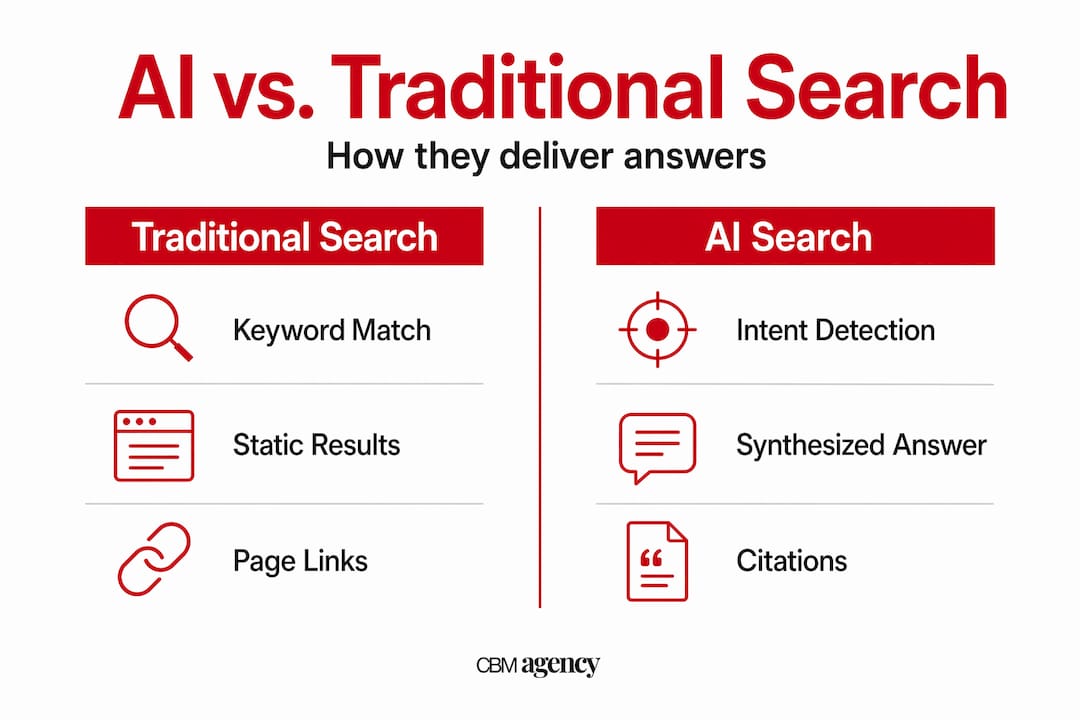
Traditional search works by matching keywords in your query to keywords on web pages, then ranking those pages by relevance and authority. You type "limo service Chicago," and Google returns a ranked list of links. You click. You browse. You decide.
AI search works differently. As of 2026, an AI search engine interprets user intent and synthesizes information from multiple sources into a direct answer, plus citations, rather than just returning ranked link lists. A user asking "what's the best black car service for airport rides in Miami?" gets a summarized recommendation with sources attached, not just ten links to sort through.
Here's what that shift actually means in practice:
- Natural language understanding: AI search handles conversational questions, not just keyword phrases. Users ask complete questions the way they'd ask a friend.
- Answer synthesis: The system pulls from multiple web sources and builds a single coherent response, citing where that information came from.
- Source citation: Unlike a ranked list, AI answers explicitly name the sources behind each claim, which matters enormously for which businesses get mentioned.
- Intent-driven results: AI search interprets context. "Affordable airport transfer" and "cheap airport car service" may return similar results because AI understands they mean the same thing.
Understanding these AI search behaviors is the starting point for any transportation provider who wants to stay visible in a rapidly changing search environment.
How AI search works: retrieval-augmented generation and hybrid retrieval
Now that we know what AI search is, let's explore how it actually works under the hood to deliver accurate, context-rich answers.
The core technology behind most modern AI search tools is called retrieval-augmented generation, or RAG. Think of RAG as a three-step process that separates AI search from a chatbot that just makes things up:
- Document retrieval: When a user submits a query, the system scans an index of web content and pulls the most relevant documents or page chunks.
- Prompt augmentation: Those retrieved documents get fed into the AI model as context alongside the user's question.
- Answer generation: The model generates a response grounded in those retrieved sources, citing relevant documents so users can verify the information.
The retrieval step is where most of the work happens, and it's where your content either earns a citation or gets passed over entirely.
Most AI search engines don't rely on one retrieval method. They use hybrid retrieval, which combines two approaches running in parallel. Hybrid search with BM25 keyword matching and vector similarity improves relevance by combining exact term matches with semantic understanding. BM25 is a traditional keyword relevance formula. Vector similarity uses mathematical representations of meaning to find conceptually related content even when exact words don't match.
The results from both methods get fused and reranked before the AI generates its final answer. What that means for your business: content needs to satisfy both keyword clarity and conceptual depth to surface reliably.

Pro Tip: Think of your service pages as chunks of retrievable evidence. Short, clearly labeled sections covering one specific service, location, or detail are far easier for AI systems to retrieve and use than long, undifferentiated blocks of text.
This is why generative engine optimization has become its own discipline separate from traditional SEO. The rules aren't entirely different, but the priorities shift significantly. Understanding RAG also has implications beyond search. AI supply chain use cases rely on similar retrieval logic to surface actionable data at the right moment.
Why AI search matters for transportation providers
Understanding AI search's mechanics, let's now see why these developments are critically important for transportation providers seeking more bookings and online visibility.
The most immediate issue is what's called zero-click search. 80% of consumers rely on zero-click results in at least 40% of their searches, meaning AI answers deliver enough value directly on the results page that users never visit an external site. If your business isn't mentioned in that answer, you're invisible to those users at the exact moment they're considering a booking.
"Transportation providers aiming for more bookings need semantically relevant, explicitly sourceable content, such as service areas, pricing, and booking details, to appear in AI search results." — Search Atlas
Here's what that means for your specific content strategy:
- Service area pages matter more than ever. If your content doesn't explicitly mention "airport transfers in Fort Lauderdale" or "corporate car service in downtown Miami," AI systems can't confirm you serve that area.
- Pricing transparency helps. AI search pulls explicit, verifiable details. Vague pricing or "call for a quote" language offers nothing for the system to cite.
- Vehicle types and fleet details build relevance. Mentioning "Mercedes Sprinter," "black SUV," or "executive sedan" gives AI systems specific content to match against specific queries.
- Booking steps should be stated clearly. Content that explains how to book, what to expect, and what's included gives AI search a reason to cite you as a useful source.
The providers who win in AI search visibility for transportation are those who treat their service pages as structured, citable resources, not marketing copy. That shift in mindset is worth more than any single tactic. Visibility in AI-generated answers directly correlates with content that is structured, specific, and verifiable.
How to optimize your transportation business for AI search
Having seen why AI search visibility is crucial, here are practical optimization tactics tailored for your transportation service business.
- Structure every page with clear subheadings. AI retrieval systems extract content in chunks. A page titled "Miami Airport Transfers" with subheadings like "Vehicle options," "Pickup process," and "Service areas covered" gives AI systems easy extraction points.
- Mention specific locations explicitly. Don't assume the system knows your coverage area. Name the airports, neighborhoods, and cities you serve on every relevant page.
- Include pricing context. Even ranges like "rates starting at $65 for airport pickups" give AI systems something specific to cite. It also builds trust with users who see that answer.
- Add schema.org markup. Structured data tells AI crawlers exactly what your business does, where it operates, and how to reach you. LocalBusiness and Service schema types are the most useful for transportation providers.
- Balance keyword and semantic content. Optimizing for AI search means structuring content with clear headings, scannable sections, and coverage of both exact phrases and semantic intent.
Pro Tip: Test your own pages by pasting a section into an AI search tool and asking it a question your customers would ask. If it can't answer from your content, neither can Google's AI.
Here's a quick comparison to help you prioritize your content efforts:
| Content approach | AI retrieval strength | Traditional SEO strength |
|---|---|---|
| Keyword-focused only | Weak on semantic queries | Strong for exact matches |
| Semantic-focused only | Strong on intent queries | May miss exact-match traffic |
| Hybrid keyword + semantic | Strong across both query types | Broad reach with fewer gaps |
| Unstructured long-form pages | Weak on both retrieval methods | Moderate, but slow to scan |
Hybrid retrieval failure modes mean you need explicit entity mentions like locations and vehicle types alongside broader conceptual content. Both matter. AI use cases in e-commerce demonstrate a similar pattern: structured, entity-rich content surfaces in AI answers far more reliably than promotional copy.
For a deeper look at what's working right now, the guide on ranking on AI search engines in 2026 covers tactical execution in detail.
The evolving role of AI search in customer discovery and booking journeys
To fully leverage AI search, it's important to understand how it reshapes customer journeys from discovery to booking.
Here's what actually happens when a potential client searches for a transportation service today. They might start with a conversational AI query, read the synthesized answer, click one of the cited sources to verify, then search again with a more specific phrase, and finally visit your booking page directly. That's not a linear funnel. It's a decision loop.
AI answers are part of a continuous decision journey, complementing traditional search rather than replacing it. That's actually good news for transportation providers. It means your traditional SEO efforts still matter. But they need to work alongside your AI visibility strategy, not instead of it.
"Google's AI search features improve link visibility by previewing websites and highlighting original voices to increase user trust." — Google
What that looks like for your business:
- AI answers introduce you to new customers who may not have clicked a traditional result.
- Website previews within AI results give users a reason to click through when they want to verify or book.
- Cited sources earn authority signals that influence both AI rankings and traditional organic rankings.
- Multiple touchpoints require consistent content. A customer who sees your business in an AI answer, then visits your site, expects the same clarity and specifics both places.
Transportation providers who adapt to serve users at every stage of these AI-driven journeys will fill more seats than those waiting for the old funnel to come back. Strengthening your content strategy using AI SEO optimization strategies covers both ends of that journey effectively.
Why embracing AI search early can set your transportation business apart
With a grasp on how AI search works and affects your business, here's the part most providers overlook: the early-mover advantage is real, and it's closing fast.
Early optimization for AI search lets businesses capture citation equity before competition intensifies, similar to the advantages businesses gained by claiming local SEO early in the 2010s. The transportation providers showing up in AI-generated answers today aren't necessarily the biggest companies. They're the ones whose content is clearest and most citable.
Here's what we see consistently: businesses that built their pages around broad keyword phrases are struggling to appear in AI answers, even when they rank well in traditional results. That's because AI retrieval rewards specificity and structure, not just domain authority. A competitor with a smaller website but cleaner, more structured content will get cited over you if your pages are written as marketing brochures rather than informational resources.
The other pitfall is treating AI search as a separate project to tackle later. Every month you wait, competitors are being cited in answers your potential customers are reading. That citation equity compounds over time. The AI search ranking insights available now give you a clear picture of what's working.
Our recommendation: audit your top service pages this week. Check whether each one explicitly names your service areas, vehicle types, pricing context, and booking process. If it doesn't, that page is invisible to most AI search systems, regardless of how well it ranks in traditional results.
Boost your transportation business visibility with CBM Agency
Ready to turn more searches into bookings? CBM Agency specializes in helping transportation providers like you improve Google visibility, rank in AI-generated answers, and build a search presence that actually drives calls and reservations.
We work specifically with transportation businesses, which means we understand the difference between optimizing a service page for a chauffeur company and writing generic SEO content that doesn't convert. From Google Business Profile optimization to proven Google Maps results, our approach covers both traditional and AI-driven search surfaces. If you want your business cited in AI answers and ranked in local results, our AI search visibility services are built for exactly that.
Frequently asked questions
What makes AI search different from traditional keyword-based search?
AI search understands natural language and user intent, synthesizing answers from multiple sources with citations, rather than just listing ranked links for users to click through.
How can transportation providers improve visibility in AI search results?
Providers should create clearly structured content with explicit service areas, pricing, and booking details, since content with verifiable proof elements improves the chances of being sourced in AI-generated answers.
Why do AI search results sometimes reduce clicks to websites?
AI-generated answers provide needed information directly on the results page, and 80% of consumers rely on zero-click results in at least 40% of their searches, which means users often find what they need without visiting an external site.
What is retrieval-augmented generation (RAG) in AI search?
RAG is a method where AI retrieves relevant documents from an index, then uses that context to generate accurate responses. RAG combines retrieval with AI generation to produce answers grounded in current and verifiable sources rather than relying on stored training data alone.
How does hybrid retrieval improve AI search accuracy?
Hybrid search runs vector and BM25 keyword matching in parallel and fuses the results, covering both exact term matches and conceptual relevance so AI systems return more accurate, useful answers for varied query types.