

Search visibility is one of the most misread metrics in digital marketing. Most business owners assume it means ranking on page one, or they treat it as a synonym for organic traffic. It's neither. Search visibility measures your website's share of total organic search opportunity across your tracked keywords — and in 2026, that definition has grown to include AI-generated answers, zero-click results, and brand mentions that never produce a click. This guide breaks down what search visibility actually means, how to measure it accurately, and what you can do to improve it before your competitors do.
Table of Contents
- Key Takeaways
- What search visibility actually means
- How AI is reshaping search visibility
- Measuring search visibility the right way
- How to improve search visibility in 2026
- Why search visibility drives business outcomes
- My honest take on where search visibility is headed
- Ready to improve your search visibility?
- FAQ
Key Takeaways
| Point | Details |
|---|---|
| Visibility is not rankings | Search visibility measures your share of organic opportunity, not just where you rank on a given keyword. |
| AI has changed the rules | AI Overviews reduce click-through rates significantly, making brand presence in AI results a separate but critical visibility goal. |
| Top 5 positions drive results | Positions beyond the top 5 capture a fraction of clicks, so visibility drops sharply as you fall down the page. |
| Measurement needs multiple signals | Track impressions, SERP feature ownership, branded search demand, and AI citations alongside organic sessions. |
| Content structure determines AI inclusion | Clear, modular, authoritative content is what AI systems pull from when generating answers. |
What search visibility actually means
The search visibility definition used by most SEO platforms is straightforward: it's an aggregated percentage representing how much of the available organic search traffic your site captures across a set of tracked keywords. The formula weights your ranking position, the monthly search volume of each keyword, and the expected click-through rate for that position.
Here's what makes it useful. A site ranking first for a 10,000-search-per-month keyword gets weighted far heavier than one ranking fifth for a 200-search-per-month keyword. That's why visibility as a percentage tells you more about real opportunity than a raw ranking report ever could.
Position matters enormously in this calculation. Top search positions capture nearly 40% of clicks, while positions 8 through 10 see only 1.6 to 2.1% CTR. Anything beyond position 10 captures less than 1% of available clicks. So when you drop from position 3 to position 7, your visibility score falls hard, even if you still appear on page one.
Visibility and traffic are not the same number. A 20% drop in search visibility typically produces a 15 to 25% decline in organic traffic within two to four weeks. But that relationship is loosening. With AI Overviews and featured snippets increasingly answering queries directly in the results page, your visibility score can stay high while your click volume falls. That's not a platform glitch. That's the new reality.

Pro Tip: Set up separate visibility tracking for branded versus non-branded keyword groups. A rising branded visibility score while non-branded stalls often signals that your SEO is building awareness, even if traffic reports look flat.
How SERP features change your visibility score
Featured snippets, knowledge panels, and People Also Ask boxes are now part of the visibility calculation. If you own the featured snippet for a high-volume query, your effective visibility for that keyword is higher than position one. If an AI Overview appears above your listing and answers the question before anyone clicks, your listed position matters less than your presence inside that AI block.
How AI is reshaping search visibility
The search results page you knew three years ago no longer exists. Google's AI Overviews now appear on a growing share of queries, and they're not neutral bystanders. AI Overviews reduce CTR for top-ranking content by approximately 58%. Only 38% of pages cited inside those AI Overviews also rank in the traditional top 10 organic results. That's a critical gap you need to understand.
What does this mean for your visibility strategy? Several things:
- Your traditional SEO rank and your AI citation status are two different outcomes that require two different approaches.
- AI does not read pages linearly but extracts modular citations from well-structured content. A wall of text won't get pulled. A clearly organized answer in a well-structured page will.
- AI citation logic prioritizes domain authority over page-level backlink counts. About two-thirds of AI citations go to high-authority domains that typical link-building campaigns can't touch. Building your overall domain authority matters more now than targeting individual page metrics.
- Zero-click results are decoupling visibility from traffic entirely. Search engines are becoming answer surfaces where users consume information without clicking through. Being visible in this environment still builds brand recall. It just doesn't show up in your session count.
- Structured data accelerates AI comprehension. JSON-LD schema helps AI and search engines understand the meaning of your content, not just its text.
Pro Tip: Check which of your top-performing pages appear in AI Overviews using Google Search Console's search appearance filters. Pages getting impressions but no clicks are likely being consumed in zero-click formats. That's a signal to optimize for AI inclusion, not to abandon those pages.
For a deeper look at how to structure content for this environment, the guide on AI-first content from Cbmagencymiami covers the fundamentals in practical detail.
Measuring search visibility the right way
Most marketers check rankings and call it SEO reporting. That's measuring the wrong thing. Visibility metrics should include impressions, SERP feature ownership, AI citation frequency, and branded demand growth alongside organic sessions. Each of those signals tells you something the others can't.
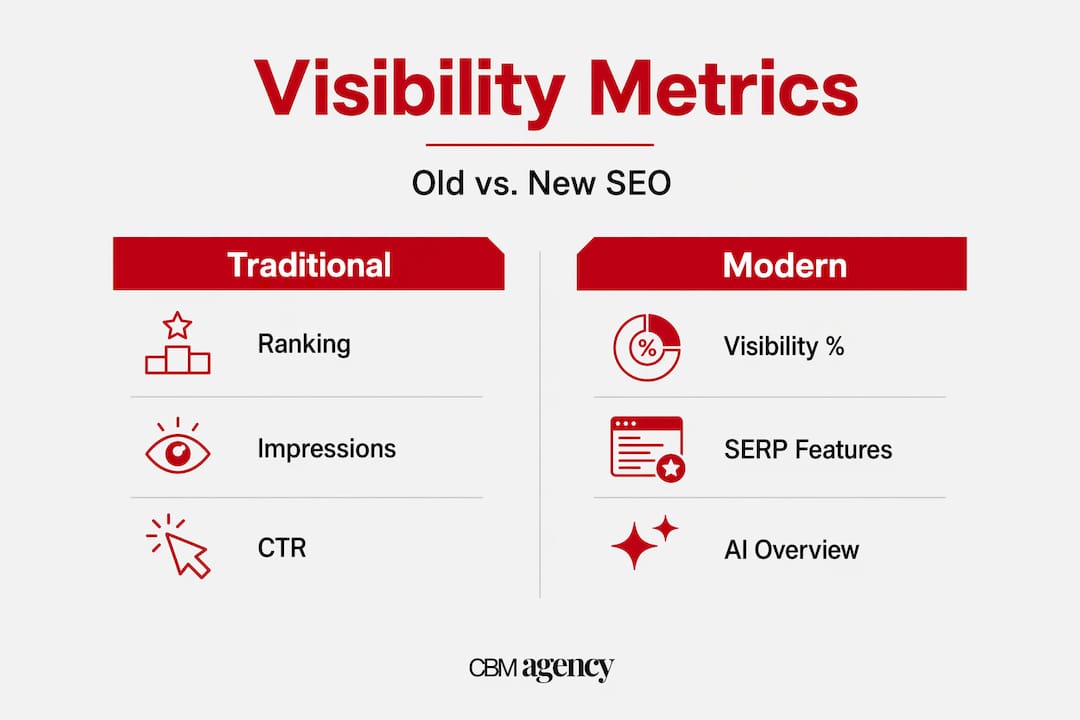
Here's a comparison of what traditional versus modern visibility measurement looks like:
| Metric | Traditional approach | Modern approach |
|---|---|---|
| Ranking position | Primary success indicator | One data point among several |
| Organic sessions | Core KPI | Adjusted for zero-click and AI impact |
| Impressions | Often ignored | Leading indicator of visibility change |
| Featured snippet ownership | Rarely tracked | Tracked per keyword cluster |
| AI citation presence | Not tracked | Monitored via AI platform testing |
| Branded search demand | Separate from SEO | Direct signal of SEO influence |
The tools that give you an aggregated visibility score include platforms like Semrush, Ahrefs, and Moz. Each calculates visibility slightly differently based on their keyword database and CTR models, so pick one and use it consistently. Switching tools mid-campaign introduces noise into your trend data.
When interpreting your visibility score, analyze by keyword buckets rather than overall averages. Segment your tracked keywords by topic, funnel stage, or page group. A service business might track visibility separately for location-based queries, service-specific queries, and informational queries. Each segment tells a different story about where your presence is growing or eroding.
Common mistakes to avoid:
- Celebrating a ranking improvement without checking if a SERP feature now sits above your result.
- Ignoring impression data in Google Search Console. A spike in impressions without clicks often flags an AI Overview capturing your traffic.
- Treating visibility and conversions as directly linked. Visibility builds the conditions for conversions. Clicks, calls, and bookings confirm them.
How to improve search visibility in 2026
Improving your visibility requires work at several layers simultaneously. Here's how to approach it in a logical sequence:
-
Fix your technical foundation first. Crawlability, page speed, mobile usability, and clean internal linking determine whether search engines can even access your content. If Google can't crawl it, it can't rank it or cite it. Run a crawl audit and address blocked pages, broken links, and duplicate content before anything else.
-
Optimize your metadata and headings. Title tags and H1 headings remain direct ranking signals. Keep title tags under 60 characters with your primary keyword positioned toward the front. Use H2 and H3 headings to structure content in ways that answer specific sub-questions. This structure is exactly what AI systems use when parsing your page for citations.
-
Create answer-first content. Put the direct answer to your reader's question in the first paragraph of each section. Don't bury the answer after three paragraphs of context. This format satisfies featured snippet requirements and gives AI systems a clean excerpt to cite. AI visibility in search demands content designed for easy parsing, not just traditional SEO ranking signals.
-
Build your authority signals. Backlinks still matter, but domain-level authority matters more for AI citation eligibility. Pursue mentions and links from recognized industry publications, directories, and association sites. For transportation and service businesses, that includes regional business profiles, local news features, and niche directories. The transport sector has specific publication ecosystems worth targeting.
-
Add structured data to your key pages. Schema markup in JSON-LD format tells both search engines and AI systems what your content is about, who created it, and what type of content it represents. Use LocalBusiness schema for location pages, FAQ schema for question-based content, and Article schema for blog posts.
-
Monitor and adapt to SERP changes. Run regular checks on your most important keywords. Note when new SERP features appear, when AI Overviews start covering your query space, and when competitors gain featured snippets. Tools that track SERP feature changes let you respond before a visibility drop shows up in your traffic report. The best AI SEO tools guide from Cbmagencymiami covers several platforms worth evaluating.
Pro Tip: Run a monthly "AI answer audit" by typing your 10 most important queries into Google and noting when AI Overviews appear, whether your brand is cited, and what source Google pulls. This gives you a ground-level read on your AI visibility that no reporting tool fully captures yet.
Why search visibility drives business outcomes
Visibility is mental shelf space. When your brand appears consistently across the queries your potential clients are asking, you earn name recognition before a single click ever happens. Branded search demand is one of the clearest signals that your SEO investment is generating real influence, even in periods when direct click volume stalls.
The business impact runs wider than most measurement frameworks capture:
- Higher visibility across early-stage queries warms your audience before they reach a decision, shortening the sales cycle when they do convert.
- Consistent SERP presence in your category builds the kind of familiarity that makes prospects choose you when they search again with commercial intent.
- Assisted conversions from organic visibility rarely show up in last-click attribution models. A potential client who saw your brand in an AI Overview three weeks before booking rarely gets credited to your SEO channel.
- Multi-dimensional visibility, including snippet ownership, AI citations, and brand mentions, compounds over time. Each new touchpoint reinforces the others.
For service businesses and transportation companies, this is especially relevant. Bookings often start with an informational search, cycle through comparison queries, and end on a branded search. Visibility at every stage of that cycle is what converts a stranger into a customer.
My honest take on where search visibility is headed
I've watched a lot of clients fixate on their keyword rankings while their actual search presence quietly eroded. The number looked fine. The traffic didn't.
In my experience, the marketers who are ahead right now are the ones who stopped treating SEO as a ranking game and started treating it as a presence game. That shift sounds subtle. The strategy change it requires is not.
What I've seen work consistently is building content that's genuinely structured to answer questions at every stage of a buyer's journey, then making sure the technical infrastructure lets Google and AI systems parse it cleanly. The businesses that are getting cited in AI Overviews are not always the ones with the most backlinks. They're the ones whose content is easiest for AI to extract a confident answer from.
The uncomfortable truth is that zero-click growth is real, and measuring its value is still messy. My advice is to stop fighting that reality and start building brand recall as a strategic goal alongside traffic. If someone sees your brand in an AI answer and then searches you by name a week later, that's your SEO working. Your analytics just won't say so.
— Meshia
Ready to improve your search visibility?
If you've read this far, you already understand that search visibility is more complex than a ranking report shows. The businesses gaining ground right now are treating visibility as a full-funnel strategy that covers traditional SEO, local search presence, and AI citation eligibility simultaneously.
Cbmagencymiami works with transportation and service businesses to build exactly that kind of presence. From Google Business Profile optimization to full SEO and AI search services, the team helps you show up where your clients are actually looking. Whether you're starting from scratch or trying to recover lost visibility, a conversation with Cbmagencymiami costs nothing. Your next booking might depend on it.
FAQ
What is search visibility in SEO?
Search visibility is a percentage score measuring how much of the available organic search traffic a website captures across its tracked keywords. It accounts for ranking position, keyword search volume, and expected click-through rate.
Why is search visibility important for my business?
Search visibility determines how often your brand appears when potential customers are actively looking for what you offer. Higher visibility builds brand recall and creates the conditions for more clicks, calls, and bookings over time.
How does AI affect search visibility?
AI Overviews reduce organic click-through rates by approximately 58% for top-ranking pages, meaning traditional visibility and traffic are no longer directly linked. Your content must be structured for AI citation to maintain presence in these results.
How do I measure search visibility?
Use SEO platforms that calculate a visibility score based on your tracked keyword rankings, then supplement with Google Search Console data covering impressions, SERP features, and branded search demand growth.
What factors affect search visibility the most?
Ranking position, keyword search volume, page crawlability, content structure, domain authority, and SERP feature ownership are the primary factors. In 2026, AI citation eligibility and structured data implementation have become equally significant.