

Your website is live, your services are listed, and your contact page is up. So why isn't your phone ringing? The answer is almost always visibility, and visibility starts with knowing why use an SEO audit before assuming your site is doing its job. Many transportation business owners are surprised to learn that large sites can have significant portions of their pages completely invisible to Google, meaning potential customers searching for your exact services never find you. An SEO audit is the diagnostic tool that reveals exactly where your online presence breaks down and gives you a clear path to fix it.
Table of Contents
- How indexing and crawl visibility affect your business
- Connecting SEO audit results to user engagement and customer inquiries
- Audit process and key focus areas for transportation websites
- Comparing common SEO audit approaches: Which works best for your transportation business?
- Applying SEO audit insights to increase customer inquiries and operational efficiency
- Why typical SEO audits fail transportation businesses and how to do it right
- Get expert SEO audit support tailored for transportation businesses
- Frequently asked questions
Key Takeaways
| Point | Details |
|---|---|
| Indexing is essential | Pages must be indexed by Google to appear in search results and be found by customers. |
| User engagement matters | SEO audits identify user experience and performance issues that impact conversions, not just rankings. |
| Prioritize existing pages | Focus audit efforts on improving pages already getting impressions for faster inquiry growth. |
| Continuous monitoring required | SEO audits are ongoing processes critical to maintaining and growing visibility over time. |
| Expert help accelerates growth | Partnering with specialists ensures audits translate into actionable, business-focused improvements. |
How indexing and crawl visibility affect your business
Before a single customer can find your transportation company on Google, your website pages need to be indexed. Indexing is the process by which Google discovers, crawls, renders, and stores your pages in its database. Think of it as Google's filing system. If your page isn't in the filing cabinet, it doesn't exist in search results.
Technical SEO audits impact your bottom line more directly than most business owners realize. A page that isn't indexed can't rank, can't attract clicks, and can't generate inquiries. For a transportation company with service pages covering different routes, vehicle types, or corporate accounts, even a handful of unindexed pages can mean thousands of missed searches every month.
"An SEO audit should be tied to indexing and crawl visibility because if Google hasn't indexed your pages, they effectively can't rank or appear in search results."
One common misconception is that controlling your robots.txt file (the document that tells Google which pages to crawl) automatically controls what gets indexed or ranked. It doesn't work that way. Blocking a page from crawling does not guarantee Google ignores it, and allowing crawling does not guarantee indexing. Many transportation websites accidentally block key service pages through overly restrictive crawl rules without ever knowing it.
The only way to know what Google is actually doing with your pages is to check Google Search Console directly. This free tool shows you which pages are indexed, which have errors, and which are being crawled but excluded. Verifying this data is the starting point of any serious SEO audit.
Now that you understand why some pages might be invisible, let's explore how audits connect technical issues to business outcomes.
Connecting SEO audit results to user engagement and customer inquiries
Rankings are only part of the story. You can rank on page one and still get almost no calls if your listing doesn't match what the searcher wants, or if your page is slow and confusing once they arrive. This is where the real importance of SEO audit work shows up for transportation businesses.
Audit results should connect to user-facing outcomes, not just a list of technical errors. Performance and UX problems that reduce engagement and conversions matter just as much as rankings, and content relevance for queries that already generate impressions can be improved without creating a single new page.
Here's what a well-executed audit looks for beyond rankings:
- Page speed issues that cause visitors to leave before your booking form even loads
- Broken contact forms or call buttons that make it impossible for customers to reach you
- Poor mobile usability on pages that most users view from their phones
- Metadata and title tags that don't match the intent of the searcher, causing low click-through rates
- Navigation gaps that leave users confused about what services you offer or where to go next
Understanding AI search behaviors for local businesses is increasingly relevant here too, since AI-powered search surfaces answers differently than traditional results, and your content needs to be structured to perform in both environments.
Pro Tip: If your page already appears in Google search results but gets almost no clicks, the problem is likely your title tag or meta description, not your ranking. Rewriting these to match what your customer is actually searching for can increase inquiries without touching anything else on the page.
Aligning your SEO best practices for logistics with conversion-focused fixes ensures you're not just chasing traffic but turning that traffic into real customer inquiries.
Audit process and key focus areas for transportation websites
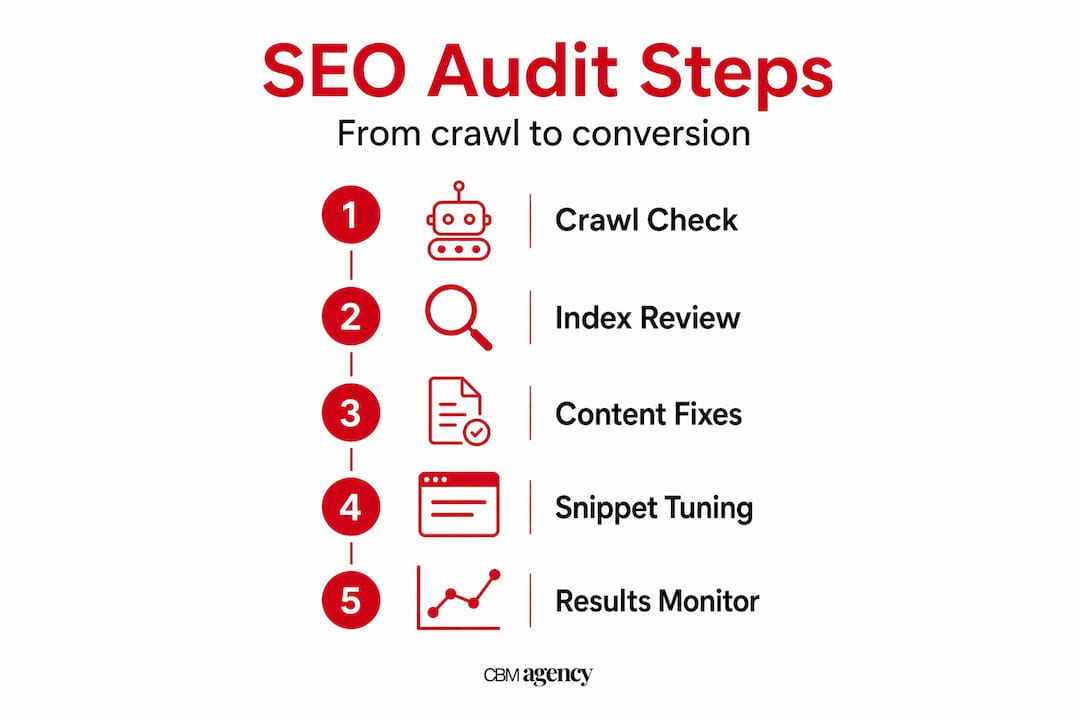
An SEO audit serves as a comprehensive evaluation of your website's visibility in search engines, identifying technical issues, content gaps, and keyword opportunities that affect your site's performance. For transportation businesses, the audit process has four clear steps.
- Crawl and indexing audit. Use Google Search Console to find unindexed pages, crawl errors, and sitemap problems. This tells you exactly which parts of your site Google can and cannot see.
- Content audit. Review each service page for keyword relevance, content quality, and alignment with what your target customers are actually searching for, such as "corporate car service Chicago" or "last-mile delivery quotes."
- UX and performance audit. Analyze page load times, mobile usability, and the path a visitor takes from landing on your site to submitting an inquiry. Friction at any point loses you a customer.
- Conversion audit. Check every contact form, call-to-action button, phone number link, and snippet to make sure they work, look trustworthy, and match what the visitor expects.
| Audit focus area | Primary tool | What you're looking for | Expected outcome |
|---|---|---|---|
| Crawl and indexing | Google Search Console | Unindexed pages, crawl errors | All key pages visible to Google |
| Content relevance | Search Console + manual review | Keyword gaps, thin content | Higher impressions for target queries |
| Page speed and UX | PageSpeed Insights | Load times, mobile issues | Lower bounce rate, more time on site |
| Conversion elements | Manual review | Broken forms, weak CTAs | More inquiries per 100 visitors |
Reviewing SEO for transportation and logistics shows that businesses in this space often have strong service offerings but weak digital presentation, and the audit process is what closes that gap.
Pro Tip: Prioritize fixing pages that already get search impressions but underperform in click-through rate or conversion. These pages are your fastest path to more inquiries because the visibility is already there.
Comparing common SEO audit approaches: Which works best for your transportation business?
Not all audits are created equal. The method you choose shapes the quality of insights you get and how quickly you can act on them.

Audits that produce the biggest inquiry lift often start with pages that already get impressions and diagnose snippet and title mismatches against search intent, rather than jumping straight to creating new pages.
| Audit type | Speed | Depth of insight | Cost | Best for |
|---|---|---|---|---|
| Automated tool audit | Fast | Surface-level technical errors | Low to moderate | Initial scans, ongoing monitoring |
| Manual expert audit | Slower | Deep, business-specific insights | Higher | Conversion-focused fixes, strategy |
| Hybrid audit | Moderate | Broad technical plus strategic | Moderate | Most transportation businesses |
Here are the risks of relying on the wrong approach:
- Automated-only audits flag hundreds of issues without telling you which ones actually cost you bookings
- Ignoring user engagement metrics like bounce rate and CTR means fixing technical errors that have no real business impact
- Skipping conversion elements in favor of pure ranking fixes leaves money on the table even when traffic improves
- One-time audits without follow-up monitoring miss the ongoing algorithm changes that affect your visibility
Reviewing your SEO services overview can help you understand what a full-service approach looks like compared to a quick automated scan.
Applying SEO audit insights to increase customer inquiries and operational efficiency
Knowing what's wrong is only useful if you act on it. The reasons to perform an SEO audit go beyond generating a report. The real value is in the prioritized action plan that follows.
An SEO audit helps identify friction points that stop conversions, such as broken contact forms or poor metadata, and aligns SEO fixes with business goals to impact your bottom line directly.
Here's how to apply audit findings effectively:
- Fix indexing errors first. If Google can't see your pages, nothing else matters. Resolve crawl errors and resubmit your sitemap.
- Rewrite underperforming metadata. Update title tags and meta descriptions on pages that get impressions but few clicks. Match the language your customers use.
- Repair conversion paths. Test every contact form, phone link, and booking button. One broken form can cost you dozens of inquiries per month.
- Improve page speed on high-traffic pages. Even a two-second improvement in load time can meaningfully reduce your bounce rate.
- Refine content for search intent. Adjust service page copy to answer the specific questions your customers are asking, not just describe what you offer.
- Monitor results consistently. Track impressions, CTR, and inquiry volume weekly after fixes to measure real impact.
Understanding SEO content growth strategies gives you a longer-term view of how audit-driven fixes compound over time into sustained visibility growth.
Pro Tip: Don't let audit reports collect dust. Pick your top three actionable fixes and complete them within the first week. Momentum matters more than perfection when your fleet stays parked waiting for bookings.
Why typical SEO audits fail transportation businesses and how to do it right
Here's an uncomfortable truth: most SEO audits fail not because the data is wrong, but because the findings never connect to what actually matters for your business. A report listing 200 technical errors is not an action plan. It's noise.
The biggest mistake we see transportation business owners make is treating an audit as a one-time event. Google's behavior changes. Your competitors update their sites. New pages get accidentally blocked. Without ongoing verification of what Google is actually indexing, you're flying blind.
Don't treat robots.txt and crawl controls as safe visibility fixes for missing rankings. You must verify what Google is actually doing rather than assuming blocking or crawling changes will fix your rankings. We've seen transportation companies accidentally exclude their most important service pages from indexing through a single misplaced robots.txt rule, and they had no idea for months.
Another common failure is building new content when existing pages already have traction. If a page ranks on page two for "airport shuttle service Miami" and gets 500 impressions a month but almost no clicks, the fix is a better title tag, not a new page. That's a quick win most audits miss entirely.
Technical SEO insights for logistics businesses show that the gap between a good audit and a great one is almost always prioritization. The best audits rank fixes by business impact, not by technical severity.
Audit success is not measured by the number of errors found. It's measured by how many of those fixes turned into more calls, more bookings, and more revenue.
Pro Tip: Structured data markup (the code that helps Google understand your content) and snippet optimization are two of the most underused tools in transportation SEO. Adding schema markup for your service areas, business hours, and reviews can increase your click-through rate without changing your ranking position at all.
Get expert SEO audit support tailored for transportation businesses
Your website should work as a booking engine, not a brochure. If it's not generating consistent inquiries, an expert audit is where the turnaround begins.
At CBM Agency, we specialize in professional SEO services built specifically for transportation and local service businesses. We don't hand you a list of errors and walk away. We identify the exact visibility barriers and conversion friction points holding your business back, and we fix them with your inquiry volume as the target metric. Combining your audit with Google Business Profile optimization and local marketing services creates a compounding effect that puts your business in front of more customers across every channel they use to search.
What you get when you work with us:
- Expert audit insights tailored to the transportation industry
- Targeted fixes prioritized by business impact, not just technical score
- Ongoing monitoring so you stay visible as Google evolves
- Clear reporting that connects SEO improvements to actual inquiry growth
Ready to stop guessing and start growing? Reach out to CBM Agency and let's turn your audit findings into real bookings.
Frequently asked questions
What exactly is an SEO audit and why is it important for my transportation business?
An SEO audit is a thorough review of your website's technical setup, content, and user experience that identifies issues preventing your site from ranking and converting visitors into customers. As one source puts it, an SEO audit serves as a comprehensive evaluation of your website's visibility in search engines.
How does indexing impact my website's visibility on Google?
Only pages that Google indexes can appear in search results, making indexing the foundation of all SEO efforts. Pages that aren't indexed don't rank or appear in search results, no matter how good your content is.
Can an SEO audit help increase the number of customer inquiries?
Yes, by identifying and fixing user experience issues, content mismatches, and conversion obstacles, audits help turn site visitors into actual customer inquiries. An SEO audit identifies friction points that stop conversions, aligning SEO with business goals to impact your bottom line.
How often should I perform an SEO audit on my transportation website?
Most transportation businesses benefit from audits every 6 to 12 months, with lighter monthly monitoring in between. Regular SEO audits ensure you're not falling behind and help maintain or improve search rankings over time.
Is it better to use automated tools or hire experts for SEO audits?
A combination of both usually delivers the best results, covering broad technical checks and strategic, industry-specific recommendations. Hybrid audits combining automated scanning with expert analysis balance efficiency and depth for better business impact.