

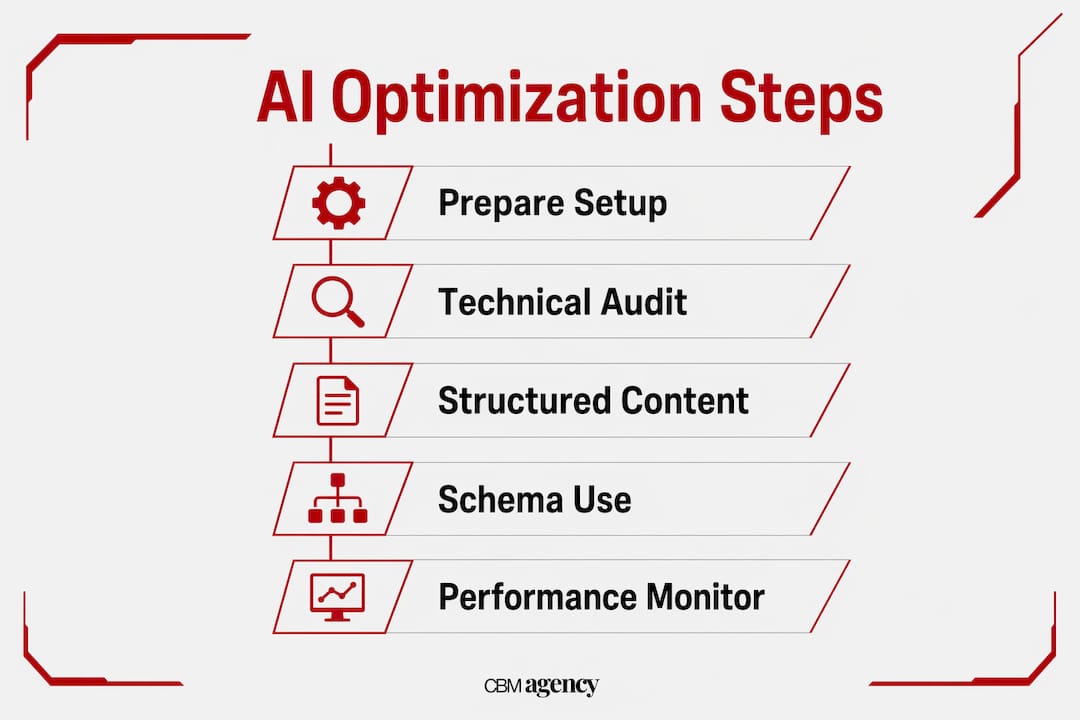
AI-powered search optimization steps are the specific actions digital marketers must take to ensure their content gets extracted, cited, and surfaced by AI search engines like ChatGPT, Perplexity, and Google AI Overviews. This is formally called Generative Engine Optimization (GEO), and it operates on different rules than traditional SEO. Ranking well no longer guarantees visibility. AI engines pull answers from content they can parse, chunk, and trust. The steps covered here address extractability, schema, crawl access, and content structure, giving you a concrete path to higher AI citations and real search visibility gains.
What are the prerequisites for AI-powered search optimization?
Before writing a single word of GEO-optimized content, your technical foundation must be solid. AI crawlers cannot cite what they cannot reach.
Start with your robots.txt file and meta tags. Allow known AI user agents such as ChatGPT-User, OAI-SearchBot, and Google-Extended to crawl your site. Blocking these bots by default is a common mistake that silently kills AI visibility before any content work begins.

Next, audit your current AI citation status. Tools like TurboAudit and Semrush AI Search Health let you benchmark how often your content appears in AI-generated answers. Without a baseline, you cannot measure progress or identify where gaps exist.
Your content management system also matters. Check whether your site delivers static HTML or server-side rendered pages. AI crawlers do not reliably process JavaScript-loaded content, so dynamic rendering can make your content invisible to the very engines you want to reach.
Finally, confirm your author and entity signals are in place before you publish:
- Schema markup for Article, FAQPage, HowTo, and Person types
- A consistent author bio with name, credentials, and links across all content
- Matching business name, address, and contact details across your website, Google Business Profile, and third-party directories
- Static page snapshots or server-side rendering confirmed in your CMS settings
How to structure content for maximum AI citation
AI search engines extract answers in 40–75 word chunks with question-form headings followed by a standalone direct answer sentence. That single fact should reshape how you write every section of every page.
Write in self-contained answer blocks
Each content block must stand alone. An AI engine pulls a passage out of context and presents it as an answer. If your paragraph relies on the sentence before it to make sense, it will not be cited. Write every block as if it is the only text the reader will see.
Use question-format headings
Phrase your H2 and H3 headings as the exact query a user would type. "What is the best schema type for AI search?" outperforms "Schema Types" every time. Content structured with question headings and direct-answer paragraphs is the format AI engines cite most frequently.
Lead with the answer, then add detail
Write one direct answer sentence immediately under each heading. Do not build to the point. State it first, then support it with evidence, examples, or context. This mirrors how AI engines present information and makes your content the natural source to pull from.
Add statistics and sourced quotations
Statistics boost AI visibility by +41% compared to prose without data. Sourced quotations add another +28% lift. Both signals tell AI engines your content is authoritative and worth citing. Every section should include at least one verifiable data point.
Use tables and numbered lists strategically
Tables produce a 4.2x higher citation rate compared to baseline prose in AI search. Use them for comparisons, feature breakdowns, and step sequences. Numbered lists work well for processes where order matters.
Here is a comparison of content formats and their AI citation impact:
| Content format | AI citation impact | Best use case |
|---|---|---|
| Comparison table | 4.2x higher than prose | Feature comparisons, option breakdowns |
| Numbered list | High for sequential steps | Processes, ranked recommendations |
| Question heading + direct answer | Most frequently cited format | All informational sections |
| Statistics with sourced data | +41% visibility lift | Claims requiring authority |
| Narrative prose only | Baseline, lowest citation rate | Background context only |
Pro Tip: Avoid implicit references like "as mentioned above" or "see the previous section." AI engines extract blocks in isolation. Any reference that requires surrounding context will reduce the passage's citation likelihood.
What technical settings does AI search require?
Technical GEO is where most content teams fall short. You can write perfect answer blocks and still get zero AI citations if your pages are not crawlable and parseable.
Crawler access and robots.txt configuration
Your robots.txt file is the first gate. Allow AI user agents explicitly. Do not assume a general "allow all" rule covers newer bots. Check your configuration against the current list of known AI crawlers and update it whenever new agents are identified.
Server-side rendering and static HTML
AI crawlers cannot extract text loaded only by client-side JavaScript. This is a hard technical limit, not a preference. If your site uses a JavaScript framework like React or Vue without server-side rendering, key content may be completely invisible to ChatGPT-User and OAI-SearchBot. Use server-side rendering or generate static HTML snapshots for all content pages.
Schema markup implementation
The four schema types with the highest measured impact are:
- Article schema: Signals content type, author, publisher, and publication date to AI engines
- FAQPage schema: Directly maps question-and-answer pairs for extraction
- HowTo schema: Structures step-by-step processes in a machine-readable format
- Person schema: Establishes author identity and expertise signals
Implementing these four schema types yields a 40–60% higher AI citation frequency compared to pages without structured data. That is not a marginal gain. It is the difference between being cited regularly and being ignored.
Entity consistency across the web
Entity consistency across web properties strongly influences how AI engines describe and cite your brand. Your business name, author names, and core topic associations must match across your website, Google Business Profile, LinkedIn, and any third-party directories. Inconsistency creates ambiguity. AI engines default to sources they can verify.
Pro Tip: Keep your Article schema's dateModified property current. Refreshing dateModified frequently sends stronger freshness signals to Perplexity and ChatGPT Search, both of which weight recency heavily in citation decisions.
How do you measure and improve AI search performance?
Measurement in GEO is not optional. AI-powered SEO demands iterative testing across multiple platforms because each engine weights signals differently. What earns a citation on Perplexity may not surface on Google AI Overviews without additional adjustments.
Follow this process to build a repeatable measurement cycle:
- Set your baseline. Use TurboAudit or Semrush AI Search Health to record your current AI citation frequency and share of voice before making changes.
- Build a prompt library. Write 20–30 queries that represent how your audience searches for your content. These become your test prompts across AI platforms.
- Run cross-engine tests. Submit your prompts to ChatGPT, Perplexity, and Google AI Overviews. Record which sources each engine cites. Note where your content appears and where it does not.
- Identify discovery gaps. The discovery-gap audit with a prompt library and cross-engine source tracking is the operational core for sustaining AI search visibility over time. Where your content is absent, diagnose the cause: crawl block, missing schema, weak answer structure, or no statistics.
- Fix and retest. Address one gap category at a time. Improve extraction quality, add schema, fix crawl issues, or insert sourced statistics. Retest the same prompts after each change to confirm the fix worked.
- Refresh content on a schedule. Update dateModified, add new statistics, and revise answer blocks quarterly at minimum. AI engines favor recency, and stale content loses citation share over time.
The goal is a living system, not a one-time audit. Each engine update and each competitor's content improvement shifts the citation landscape. Your measurement cycle keeps you ahead of those shifts.
Key takeaways
Effective AI search visibility requires extractable content, correct technical setup, and continuous cross-engine testing, not just strong traditional rankings.
| Point | Details |
|---|---|
| Allow AI crawlers explicitly | Add ChatGPT-User, OAI-SearchBot, and Google-Extended to your robots.txt file. |
| Write in 40–75 word answer blocks | Each passage must stand alone and directly answer a specific query. |
| Use tables and question headings | Tables produce 4.2x higher citation rates; question headings are the most cited format. |
| Implement four schema types | Article, FAQPage, HowTo, and Person schema yield 40–60% higher AI citation frequency. |
| Test and iterate across platforms | Run prompts on ChatGPT, Perplexity, and Google AI Overviews to find and close discovery gaps. |
What most SEO pros get wrong about AI search
The biggest mistake I see is treating AI search like a ranking problem. Marketers spend months building backlinks and chasing domain authority, then wonder why ChatGPT never cites them. The real issue is extractability, not authority. AI engines do not browse your site the way a human does. They pull specific passages. If those passages are buried in narrative prose, hidden behind JavaScript, or written without a direct answer sentence, they will not be used regardless of your domain rating.
The second mistake is skipping the technical foundation. Server-side rendering feels like a developer problem, not a marketing problem. But if your content is not in static HTML, it simply does not exist for most AI crawlers. I have seen well-written, well-researched pages get zero AI citations purely because the CMS was serving JavaScript-rendered content. Fix the technical layer first. Everything else builds on it.
The third mistake is treating GEO as a one-time project. AI engines update their weighting signals, competitors publish new content, and your own content ages. The teams that sustain AI visibility are the ones running prompt library tests monthly and refreshing content on a schedule. Optimization is a cycle, not a checklist.
— Meshia
How Cbmagencymiami can help you get cited by AI search
Cbmagencymiami works with service businesses and digital marketers who want real AI search visibility, not just traffic reports. The team handles the full implementation: crawl access audits, schema markup, content restructuring for GEO, and ongoing cross-engine monitoring.
If your content is not showing up in ChatGPT, Perplexity, or Google AI Overviews, the problem is usually technical or structural, and both are fixable. Cbmagencymiami's AI search visibility services cover the complete process from baseline audit to iterative improvement. You can also review a real-world example of what structured optimization produces in the Google Maps case study. If you want to start with local search and build from there, the Google Business Profile service is the right entry point.
FAQ
What are AI-powered search optimization steps?
AI-powered search optimization steps are specific technical and content actions that make your pages extractable and citable by AI engines like ChatGPT, Perplexity, and Google AI Overviews. They include configuring crawler access, writing in self-contained answer blocks, and implementing structured schema markup.
How is GEO different from traditional SEO?
Traditional SEO targets ranking signals like backlinks and keyword density. GEO targets extractability, meaning how well an AI engine can pull a specific passage from your page and present it as an answer. A page can rank on page one and still receive zero AI citations if the content is not structured for extraction.
Which schema types matter most for AI citations?
Article, FAQPage, HowTo, and Person schema types have the highest measured impact. Implementing all four yields a 40–60% higher AI citation frequency compared to pages without structured data.
Why does server-side rendering matter for AI search?
AI crawlers cannot process JavaScript-loaded content reliably. Pages that deliver content only through client-side JavaScript are effectively invisible to bots like ChatGPT-User and OAI-SearchBot. Server-side rendering or static HTML snapshots solve this problem directly.
How often should I update content for AI search?
Update content at minimum quarterly. Refreshing the dateModified schema property and adding new statistics sends stronger freshness signals to Perplexity and ChatGPT Search, both of which weight recency in their citation decisions.