

Most transportation businesses assume their traditional SEO work covers all the bases. It does not. The question of why optimize for AI search has a very specific answer: AI systems like Google AI Overviews, ChatGPT, and Gemini do not simply rank pages. They extract, synthesize, and cite content directly inside answers. If your limo service, charter company, or fleet operation is not structured to be pulled into those answers, you are invisible to a growing segment of travelers and corporate bookers who never scroll past the AI response at the top of the page.
Table of Contents
- Key takeaways
- Why optimize for AI search: understanding the shift
- Content that AI systems actually cite
- Technical SEO that affects your AI visibility
- How to measure and maintain your AI presence
- The real benefits for transportation businesses
- My take: why most transportation marketers miss this
- How Cbmagencymiami helps transportation businesses get cited
- FAQ
Key takeaways
| Point | Details |
|---|---|
| AI search is an extension of SEO | Google confirms AI optimization follows the same core SEO principles, with added emphasis on extractability. |
| Content quality beats content quantity | Unique, expert-led content earns AI citations; mass-produced generic pages get filtered out or penalized. |
| Technical limits affect AI visibility | Googlebot only fetches the first 2MB of HTML, so critical content buried deep in your code may be ignored. |
| Measurement matters continuously | Tracking AI citation readiness and brand mentions helps you stay visible as AI systems evolve. |
| Transportation firms have a competitive edge available | Most operators in this sector have not yet optimized for AI search, creating a real window of opportunity. |
Why optimize for AI search: understanding the shift
The industry term for this practice is generative AI search optimization, often shortened to AI search optimization. You will also hear it called GEO (Generative Engine Optimization). The primary keyword you typed to find this article is the practical question; GEO is the strategic discipline behind the answer.
Traditional search ranking placed your website URL on a results page and let users click through. AI search works differently. When someone asks Google "best corporate car service in Miami" or "luxury airport transfer near me," an AI system reads indexed content, synthesizes an answer, and may cite two or three sources directly in the response. Google explicitly states that optimizing for these generative features aligns with SEO, not against it. But there is a layer on top of traditional ranking: you must be extractable and citable, not just crawlable and ranked.
"Optimizing for generative AI search is fundamentally the same as SEO, relying on traditional technical SEO best practices." — Google Search Central
Here is what that means practically for a transportation business:
- AI systems pull specific facts, claims, and structured answers from your content
- They favor sources that are authoritative, specific, and clearly organized
- A page that ranks on page one but has vague, generic text may still be skipped by AI in favor of a competitor with a clearly worded, fact-rich page lower in traditional results
- Being AI-extractable and citable means structuring your content so AI can find, read, and trust it quickly
Understanding this distinction changes how you write service pages, blog posts, and even your Google Business Profile descriptions.
Content that AI systems actually cite

The single biggest mistake transportation marketers make is producing commodity content. Think of the generic "We offer professional, reliable, and comfortable transportation services" paragraph that appears on thousands of carrier websites. AI systems are trained to filter this out because it offers no unique value.
Google recommends content that provides a unique perspective, real evidence, and expert insight beyond what anyone could find on any other page. For a chauffeur company, that might mean a detailed breakdown of how your fleet handles last-minute corporate rerouting, or a factual comparison of airport pickup logistics at MIA versus FLL.
Pro Tip: Write at least one section per service page that answers a specific question your customer would type into an AI assistant. Phrases like "What should I expect from a Miami corporate car service?" or "How early should I book airport transportation in peak season?" give AI systems clean, citable answer material.
Beyond writing, your content structure matters just as much:
- Use clear H2 and H3 headings that describe what each section answers
- Keep answer-friendly passages short. Two to three sentences that make a specific claim beat a sprawling paragraph
- AI systems prefer content with direct answers, narrow scopes, and factual claims placed near the relevant detail
- Add images with descriptive alt text and consider short explainer videos for complex services like multi-stop corporate routes
Google has also extended its spam policies. As of May 2026, scaled content abuse rules now officially apply to AI Overviews and AI Mode. If you have been bulk-generating location pages with thin, templated copy, that practice now carries direct risk for your AI search visibility, not just traditional rankings.
The standard to meet: high volume of content does not guarantee AI search success. One well-researched, expert-written service page earns more citations than twenty generic ones.
Technical SEO that affects your AI visibility
This is the section most transportation marketers skip, and it is often the one that costs them the most visibility.
Googlebot fetches only the first 2MB of HTML per URL. Any content that appears beyond that cutoff in your page's code is simply not seen. For AI grounding specifically, this matters more than it ever did for traditional SEO. When your page loads critical service descriptions, structured data, or key entity information deep in the HTML after heavy inline JavaScript or bloated navigation code, AI grounding can fail entirely.
| Technical element | Why it matters for AI search | Recommended practice |
|---|---|---|
| HTML size | Googlebot stops reading at 2MB | Keep pages lean, load critical content first |
| Structured data | Helps AI understand entities and relationships | Use schema markup for services, reviews, and location |
| Crawlability | AI systems rely on indexed content | Check robots.txt and sitemaps regularly |
| Page speed | AI features still rely on core user signals | Target under 2.5 seconds load time on mobile |
| Mobile-friendliness | Google's AI uses the same crawl data as core search | Test every key page on mobile monthly |
Pro Tip: Run a raw HTML check on your top service pages. If your main service description appears after 1.5MB of JavaScript, inline CSS, or menu code, restructure the page to surface that content earlier in the document. This is one of the fastest wins available for AI visibility.
Good page experience, including mobile-friendliness and fast loading, remains a direct input to AI search visibility. AI systems that rely on Google's index inherit all of Google's signals. Clean code, fast pages, and accessible content are not optional extras for transportation websites chasing AI citations.
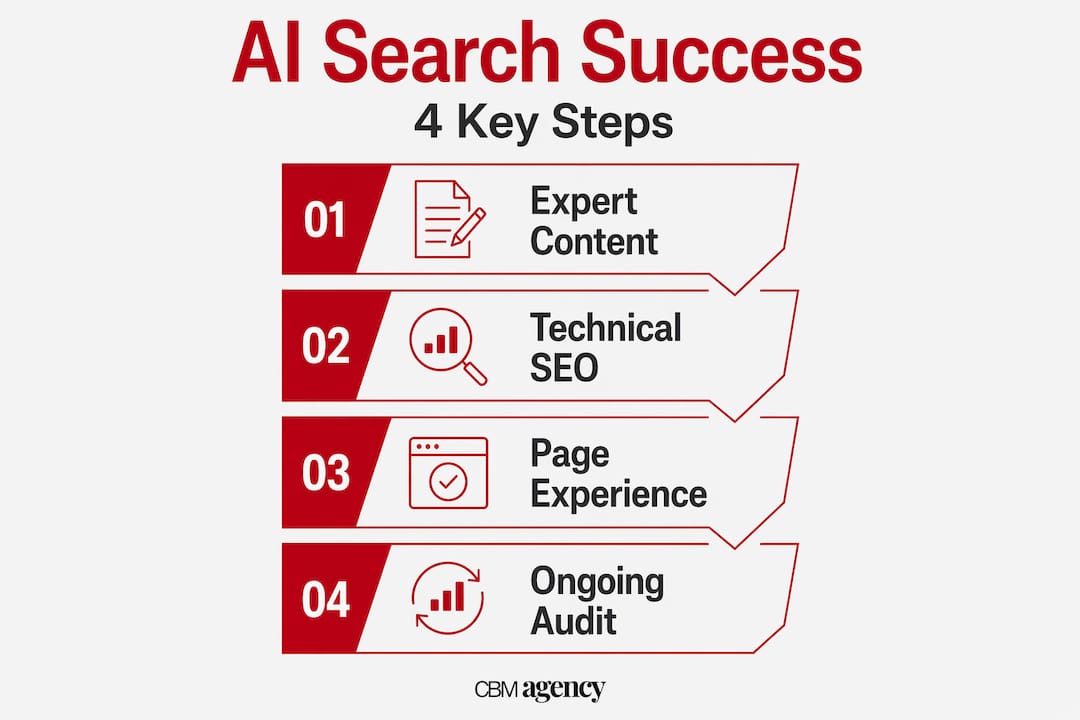
You can learn more about building a technically sound foundation in this SEO best practices guide specifically for transportation businesses.
How to measure and maintain your AI presence
Getting cited in AI answers once is not the finish line. AI systems update their grounding data continuously, and your competitors are adapting too. Here is a practical framework for staying visible:
- Audit your citation readiness. Use AI visibility tools to check whether your brand appears in AI-generated answers for your core service queries. Search ChatGPT, Gemini, and Google AI Overviews for queries like "best executive car service in [your city]" and note who gets cited.
- Track brand mentions across AI surfaces. Tracking brand mentions and answer inclusion is now as important as tracking keyword rankings. Tools like Brandwatch, Semrush, or dedicated GEO trackers can surface this data.
- Refresh content on a schedule. AI systems favor content that signals recency and accuracy. Update service pages with current fleet information, seasonal pricing notes, or new route coverage at least quarterly.
- Publish balanced comparison content. Pages that fairly compare your services against general market options tend to earn more AI citations because they are seen as informational rather than purely promotional. A page titled "Private Car Service vs. Rideshare for Corporate Travel" has strong citation potential.
- Monitor competitor AI visibility. If a competing car service suddenly starts appearing in AI answers for queries you target, analyze their content structure. What question are they answering that you are not?
The importance of AI search strategies becomes clearest when you run this audit and realize a competitor with fewer reviews and a lower domain authority is getting cited simply because their content is better structured for extraction.
The real benefits for transportation businesses
Pull it all together and the case for AI search optimization in transportation becomes straightforward.
| Benefit | What it means for your business |
|---|---|
| Increased AI surface visibility | Your brand appears in zero-click answers where traditional links do not show |
| Improved trust and authority | AI citations signal credibility, which compounds into user trust and more bookings |
| Competitive advantage | Most transportation operators are not doing this yet |
| Better alignment with how users search | Corporate bookers and travelers increasingly use AI assistants for service discovery |
The advantages of an AI-centric optimization approach go beyond rankings. When a corporate travel manager asks an AI assistant for a reliable executive car service in your city and your company is the one cited, that is not a click. That is a direct recommendation from a source the user already trusts.
Transportation firms that act on this now will be difficult to displace once AI systems have repeatedly confirmed them as credible sources. The ones that wait will spend significantly more effort catching up later.
My take: why most transportation marketers miss this
I have worked with transportation businesses that had strong Google Maps profiles, solid review counts, and years of SEO investment, yet they still did not appear in a single AI-generated answer. When I dug into their content, the reason was consistent. Their pages were written for humans skimming for a phone number, not for an AI system looking for a citable, structured claim.
The uncomfortable truth is that a lot of transportation website content is essentially a digital brochure. It describes services without ever making a specific, extractable claim. There is no answer to a real question. There is no evidence. There is just marketing language that AI systems have no reason to repeat.
I have also seen the technical side bite hard. One client had their entire structured data block loading after a 1.8MB JavaScript bundle. Googlebot never read it. The fix took two hours and changed their AI visibility completely.
My honest advice: stop treating AI search optimization as a separate project to tackle someday. Treat it as the standard your content should already meet. If your page cannot be cited in an AI answer, it probably is not as useful as you think it is.
— Meshia
How Cbmagencymiami helps transportation businesses get cited
At Cbmagencymiami, we work specifically with transportation and service businesses to close the gap between where you rank today and where AI systems actually cite you. That includes AI visibility audits, content restructuring for citation readiness, and Google Business Profile optimization that feeds both traditional and AI-powered local search. We have documented these results in our Google Maps case study, which shows exactly how visibility improvements translate into real bookings. If you want a clear picture of where your transportation business stands in AI search today, reach out for an evaluation. Your competitors are not standing still, and neither should your search strategy.
FAQ
What is AI search optimization?
AI search optimization, also called GEO (Generative Engine Optimization), is the practice of structuring and writing content so AI-powered systems like Google AI Overviews, ChatGPT, and Gemini can extract and cite it in generated answers.
Does AI search optimization replace traditional SEO?
No. Google confirms that AI search optimization is an extension of SEO, not a replacement. The same technical and content fundamentals apply, with added emphasis on content extractability and entity clarity.
How do I know if my transportation website is AI-ready?
Search for your core service queries in ChatGPT, Gemini, and Google AI Overviews. If your brand does not appear in the generated answers, your content likely lacks the structure, specificity, or authority needed for AI citation.
Why does content quality matter more than volume for AI search?
AI systems are trained to surface unique, expert-backed content and to filter out mass-produced generic pages. Google's spam policies now explicitly cover AI Overviews, meaning low-quality scaled content carries real penalties.
What is the biggest technical mistake that hurts AI visibility?
Placing critical content, service descriptions, and structured data late in a page's HTML code. Googlebot fetches only the first 2MB of a page, so content buried after heavy scripts may never be read or grounded by AI systems.