

Content marketing is defined as the practice of creating and distributing valuable, relevant, and consistent content to attract a clearly defined audience and drive profitable customer action. The role of content marketing goes far beyond publishing blog posts. It builds brand authority, generates qualified leads, and creates trust that paid ads simply cannot buy. For marketing professionals and business owners, understanding how content marketing works is the difference between a pipeline that grows on its own and one that dries up the moment your ad budget drops.
What role does content marketing play in business results?
Content marketing is the engine behind brand visibility, lead quality, and customer retention. 87% of marketers report that content marketing increases brand awareness. That figure reflects a consistent pattern: businesses that publish useful content get found, get trusted, and get chosen.
The lead generation numbers are equally direct. Content marketing generates 3x more leads than outbound marketing at 62% less cost. That cost gap matters because it means you can build a larger, more qualified pipeline without proportionally increasing spend.
"Content marketing builds trust by educating and guiding buyers, turning attention into revenue sustainably." — Hypesuite AI
The importance of content marketing also shows up in places most business owners overlook. Effective content reduces support tickets and accelerates time-to-value for new customers. That means your content team is also doing part of your customer success team's job.
| Benefit | Stat or Outcome |
|---|---|
| Brand awareness | 87% of marketers report a measurable boost |
| Lead generation | 3x more leads than outbound at 62% less cost |
| Email ROI | $36–$42 return per $1 spent when layered on content |
| Content ROI | Averages $7.65 for every $1 spent |
| Traffic growth | Bloggers see 55% more monthly website traffic |
How does a documented content marketing strategy amplify results?
A documented content marketing strategy is not a content calendar. It is a written plan that connects every piece of content to a specific business goal, a buyer stage, and a measurable outcome. Most teams skip this step and wonder why their content produces traffic but not revenue.

Brands with documented strategies are 60% more likely to report effective results than those without one. The gap is not about creativity. It is about alignment. When your content maps to the buyer journey, each piece does a specific job.
A documented strategy covers four areas:
- Audience definition. Who you are writing for, what questions they ask, and where they are in the buying process.
- Content mapping. Assigning content types to each funnel stage. Blog posts for awareness, case studies for consideration, comparison pages for decision.
- Distribution plan. Where content gets published, how it gets promoted, and who is responsible for each channel.
- Measurement framework. Which metrics connect content activity to revenue, not just traffic.
Documented strategies generate 3x more leads per dollar than informal approaches. That multiplier comes from compounding. Each piece of content reinforces the next, builds topical authority, and keeps your brand visible across the entire buyer journey.
Pro Tip: Avoid publishing content just to fill a schedule. Every piece should answer a specific question your buyer is already asking. If you cannot name the question, do not publish the piece.
What types of content best fulfill the content marketing mission today?
Content marketing effectiveness depends heavily on format. Different formats serve different goals, and the best programs use several in combination.
- Long-form blog posts drive organic search traffic and backlinks. Content over 3,000 words earns 3x more traffic and 4x more backlinks than shorter posts. That is not an argument for padding. It is an argument for depth.
- Case studies convert consideration-stage buyers. They show proof, not promises.
- Videos build trust faster than text for audiences who prefer visual learning.
- Email newsletters amplify everything else. Email layered on content programs delivers $36–$42 return per $1 spent. Segmented email campaigns drive conversion rates up by 22%.
- Whitepapers and guides position your brand as the authority in a niche.
| Content Type | Funnel Stage | Primary Goal | Relative ROI |
|---|---|---|---|
| Blog posts | Awareness | Traffic and discovery | High over time |
| Case studies | Consideration | Trust and proof | High for B2B |
| Email newsletters | All stages | Nurture and convert | Very high |
| Videos | Awareness/consideration | Engagement | Medium to high |
| Whitepapers | Consideration | Authority and lead capture | High for B2B |
Topic clusters are the structural backbone of content marketing in digital strategy. A cluster groups a pillar page with several supporting articles, all interlinked. Interconnected topic clusters reinforce credibility and boost SEO performance. Google reads the cluster as a signal that your site owns a topic, not just a keyword.
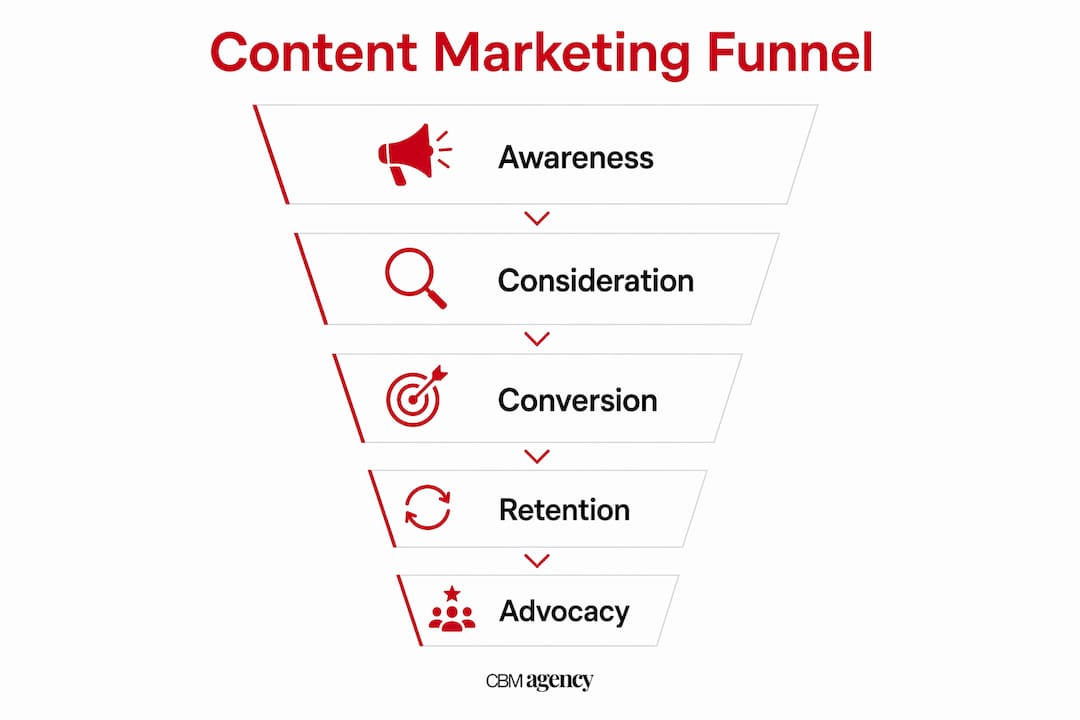
Content also compounds. A blog post published today can drive traffic for three to five years. Content's return on investment grows over time, unlike paid ads that stop the moment you stop paying. That compounding effect is what makes content a durable business asset, not just a marketing tactic.
Pro Tip: For transportation and service businesses, a content and SEO strategy built around local search terms and service-specific questions will outperform generic industry content every time.
How can businesses integrate content marketing into their revenue strategy?
Content marketing effectiveness is highest when it connects directly to revenue targets, not just traffic goals. Most businesses treat content as a separate function. The ones that grow fastest treat it as a core part of their sales and retention system.
Here is how to build that connection:
- Align content goals with revenue metrics. Track which content pieces generate leads, not just pageviews. Use UTM parameters and CRM tagging to connect content to closed deals.
- Use content as a risk buffer. Content marketing stabilizes traffic and revenue even when paid budgets shrink. When Google Ads costs spike or a campaign underperforms, organic content keeps the pipeline moving.
- Integrate content with paid campaigns. Retarget visitors who read your blog posts with paid ads. Use high-performing organic content as the basis for paid social creative. The two channels reinforce each other.
- Measure content ROI directly. Content marketing ROI averages $7.65 for every $1 spent, with the top 20% of content generating over 500% returns. That spread means you need to identify your best performers and produce more content like them.
- Connect content to onboarding. Use guides, tutorials, and FAQ pages to reduce customer questions after the sale. This shortens onboarding time and increases satisfaction.
68% of B2B marketers use content marketing as a core strategy for lead generation and nurturing. That adoption rate reflects a simple truth: content is one of the few marketing channels that gets cheaper and more effective the longer you run it.
For service businesses, the on-page SEO tactics that support content marketing are just as important as the content itself. A well-written article that no one can find does not generate leads.
Pro Tip: Prioritize depth over volume. One thoroughly researched, well-structured article beats five thin posts every time. Publish less, but make each piece the definitive answer to a question your buyer is already searching.
Key Takeaways
Content marketing builds compounding business value when it is documented, audience-specific, and connected directly to revenue metrics rather than treated as a standalone publishing activity.
| Point | Details |
|---|---|
| Define before you publish | Every piece of content must map to a buyer stage and a specific business goal. |
| Document your strategy | Brands with written strategies are 60% more likely to report effective results. |
| Use topic clusters | Interlinked content groups signal topical authority to Google and build trust with readers. |
| Layer email on content | Email amplification delivers $36–$42 per $1 spent when paired with strong content programs. |
| Measure revenue, not just traffic | Connect content to closed deals using CRM tagging and UTM tracking to prove real ROI. |
Why content marketing is the only channel that gets better with age
Most marketing channels depreciate. You pay for an ad, it runs, it stops. You pay again, it runs again. Content does the opposite. A well-researched article published in january can still rank, generate leads, and build trust in december of the following year without any additional spend.
What I have seen consistently is that businesses underestimate the patience content marketing requires and overestimate how fast paid ads will solve their visibility problem. The businesses that win with content are not the ones with the biggest budgets. They are the ones that commit to a documented plan and execute it without flinching when results take three months to show up.
The most common mistake I see is treating content as a volume game. Teams publish five posts a week, none of them definitive, none of them built around a real buyer question. The result is a blog with thousands of posts and almost no organic traffic. The fix is not more content. It is better content, mapped to real search intent, built into topic clusters, and promoted through email and social.
Content marketing is also the best risk-mitigation tool a business has. When paid budgets get cut, companies with strong content programs barely notice. Their organic traffic keeps coming. Their email list keeps converting. Their case studies keep closing deals. That stability is worth more than any short-term campaign result.
The brands that treat content as a long-term investment, not a quick fix, are the ones that build real market authority. Start with one pillar topic, build three to five supporting articles around it, and measure what moves. Then repeat.
— Meshia
How Cbmagencymiami helps you turn content into real business results
Cbmagencymiami works with transportation and service businesses that need more than a content calendar. You need a system that connects content to Google visibility, local search rankings, and actual bookings.
The team at Cbmagencymiami builds content programs that are tied directly to search intent, local SEO, and AI-powered search visibility. If you want to see what that looks like in practice, the Google Maps case study shows exactly how service businesses have turned search presence into measurable revenue. Content is not a brochure. In the right hands, it is a booking engine. Cbmagencymiami builds it that way from day one.
FAQ
What is the primary role of content marketing?
Content marketing's primary role is to attract and engage a defined audience by delivering useful, relevant content that builds trust and drives profitable action. It supports brand awareness, lead generation, and customer retention across the entire buyer journey.
How does content marketing compare to paid advertising?
Content marketing generates 3x more leads than outbound marketing at 62% less cost, and its ROI grows over time. Paid ads stop producing results the moment you stop spending.
How long does it take for content marketing to show results?
Most content programs take three to six months to produce measurable organic traffic and lead generation results. Content compounds over time, so results accelerate as your library of interlinked content grows.
What makes a content marketing strategy effective?
A documented strategy that maps content to buyer stages, tracks revenue outcomes, and builds topic clusters is the most effective approach. Brands with written strategies are 60% more likely to report strong results than those without one.
Does content marketing work for service and transportation businesses?
Content marketing works especially well for service businesses because buyers research before they book. Publishing content that answers local search questions and demonstrates expertise puts your business in front of buyers at the exact moment they are deciding.