

On-page SEO is defined as the practice of optimizing webpage content and HTML elements so search engines can understand your pages and users find them genuinely useful. It covers everything visible on your page, including title tags, headings, meta descriptions, URLs, internal links, and images, as well as the underlying code that shapes how Google reads each element. Tools like Google Search Console and Semrush are built around this discipline because getting it right is the fastest way to move a page up in organic rankings. On-page SEO sits alongside technical SEO and off-page SEO as one of three core pillars, but it is the one you control most directly. If your pages are not optimized at the content level, no amount of backlinks will fully compensate.
What is on-page SEO and why does it matter?
On-page SEO is the set of decisions you make on each individual page to signal relevance, authority, and usefulness to both Google and your visitors. A strong on-page foundation improves crawlability, indexation, user experience, and organic rankings, even when off-page signals are limited. That matters for website owners and marketers because you can act on it today without waiting for third parties to link to you or mention your brand.
Think of each page on your site as a pitch to Google. The clearer and more organized that pitch, the better Google understands what your page is about and who should see it. When your content answers real questions, uses logical structure, and loads fast on a phone, Google rewards you with visibility. When it does not, your page competes at a disadvantage regardless of your domain age or backlink count.
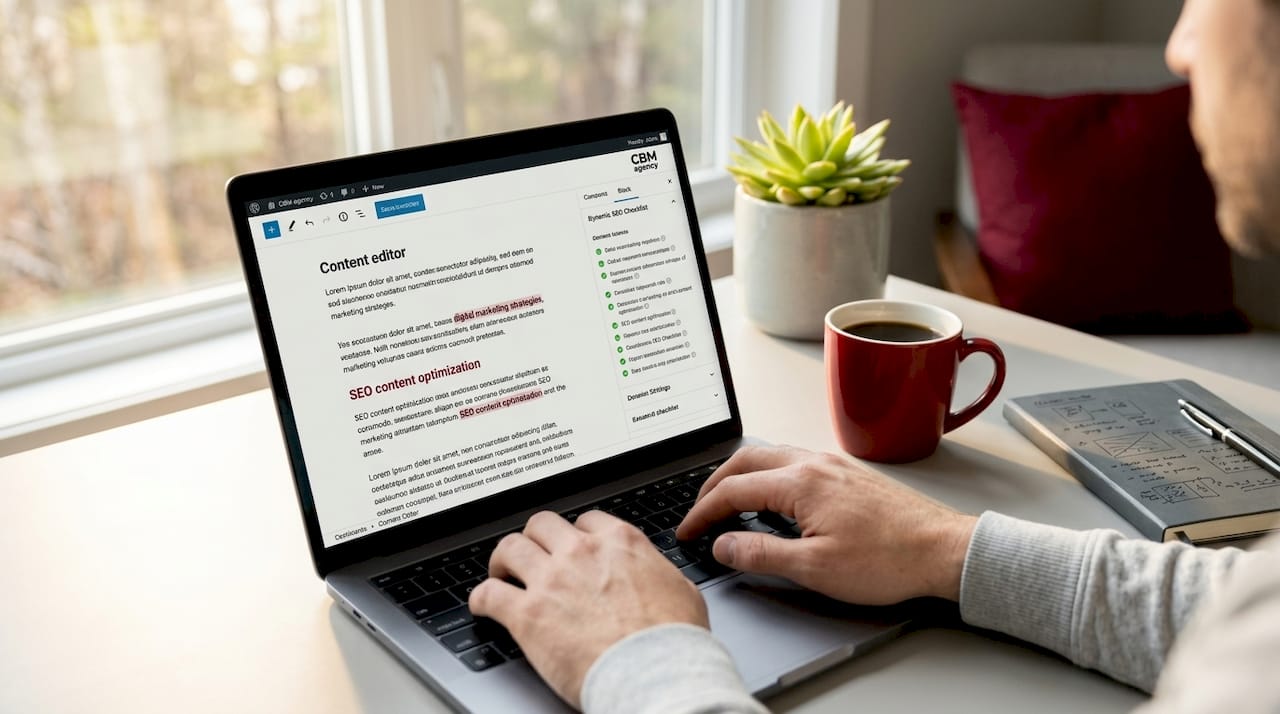
The importance of on-page SEO also extends to user behavior. Pages that are well-structured reduce bounce rates, increase time on site, and convert more visitors into customers or leads. For transportation businesses, a service page that clearly answers "what areas do you cover" and "how do I book" will outperform a vague page every time, both in rankings and in revenue.
What are the critical components of on-page SEO?
Every page you publish has several elements that Google evaluates. Each one is a signal, and together they tell a coherent story about your content.
- Title tags: Your title tag is the headline Google shows in search results. Title tags should be concise, under roughly 60 characters, with your primary keyword placed near the beginning. A title like "Miami Airport Car Service | Book Online" tells Google and the user exactly what the page is about before they click.
- Meta descriptions: These are the short summaries shown beneath your title in search results. Meta descriptions perform best between 155 and 160 characters and should include a clear description of the page plus a call to action. They do not directly affect rankings, but they drive click-through rates, which do.
- Heading structure: Use one H1 per page that matches your primary topic, then organize subtopics under H2 and H3 headings. A clear heading hierarchy improves content scanability and helps search engines understand page structure and relevance.
- URL structure: Keep URLs short, descriptive, and keyword-inclusive. A URL like "/miami-airport-car-service
beats/page?id=482` in both readability and ranking potential. - Keyword placement: Keywords should appear naturally in your title tag, headings, URL, and within the first 100 words of your content. This signals to Google immediately what the page covers.
- Internal links: Link to related pages on your site using descriptive anchor text. Descriptive anchor text helps search engines crawl your site and understand the context of linked pages. "Book a corporate car service" is far more useful than "click here."
- Image optimization: Every image needs a descriptive alt attribute. Optimizing image alt text improves accessibility for screen readers and helps Google interpret visual content on the page.
Pro Tip: Run your title tags through a free SERP preview tool like Mangools or Portent before publishing. Seeing exactly how your title and meta description appear in search results often reveals truncation or messaging issues you would otherwise miss.
How does on-page SEO differ from off-page and technical SEO?
Understanding where on-page SEO ends and the other two pillars begin helps you prioritize your work. On-page SEO controls page-level content and structure to help search engines understand relevance. Off-page SEO covers external signals you do not fully control, like backlinks, brand mentions, and reviews. Technical SEO handles the infrastructure: site speed, crawlability, indexing, schema markup, and mobile usability.
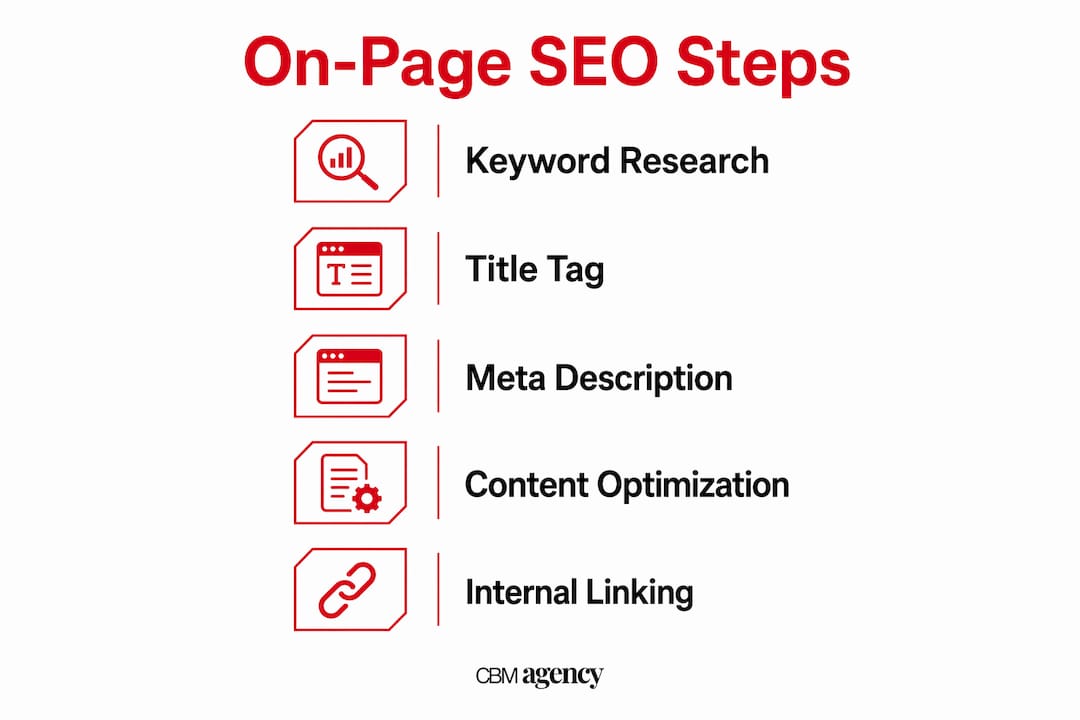
Here is how the three pillars compare:
| SEO Pillar | Primary Focus | What You Control | Examples |
|---|---|---|---|
| On-page SEO | Content and HTML elements on each page | High | Title tags, headings, meta descriptions, internal links |
| Off-page SEO | External signals and authority | Low | Backlinks, brand mentions, Google Business Profile reviews |
| Technical SEO | Site infrastructure and crawlability | Medium | Page speed, XML sitemaps, schema markup, mobile responsiveness |
All three pillars work together. A page with perfect on-page optimization but zero backlinks will struggle for competitive terms. A page with strong backlinks but poor on-page signals will underperform its potential. Technical issues like slow load times or broken crawl paths can neutralize both. The most effective SEO programs address all three, but on-page work is typically where you start because it produces results with the least dependency on outside parties.
For service businesses, this distinction is especially practical. You can rewrite a title tag this afternoon. You cannot manufacture 50 backlinks by Friday. Starting with on-page SEO gives you control and measurable progress from day one.
What are best practices for optimizing on-page SEO?
Effective on-page SEO strategies require you to write for people first and optimize for search engines second. Content optimized for both search engines and users simultaneously produces the best outcomes. Here is how to apply that principle in practice:
- Lead with the answer. Structure your content so the most important point appears first. Answer-first content sectioning improves scanability and increases your chances of appearing in Google's featured snippet boxes. Users and crawlers both reward pages that get to the point quickly.
- Align your SERP snippet with your page content. Your title tag, meta description, and H1 should tell the same story. Misalignment between snippet and content causes Google to substitute its own text and increases bounce rates when users land on a page that does not match what they expected.
- Use keywords naturally, not mechanically. Placing your keyword in the title, H1, and first paragraph is correct. Repeating it in every sentence is not. Over-optimizing headings and metadata for keywords rather than topical depth risks thin content penalties and lower rankings.
- Prioritize mobile and load speed. Google uses mobile-first indexing, meaning it evaluates your mobile page version first. A page that loads in under three seconds on a phone and displays cleanly without horizontal scrolling will outrank a slower, desktop-only version of the same content.
- Build internal links with purpose. Every page you publish should link to at least two or three related pages on your site. Use anchor text that describes the destination page's topic, not generic phrases. This guides both users and Google's crawlers through your content architecture.
- Optimize every image before uploading. Compress images using tools like TinyPNG or Squoosh, write descriptive filenames (miami-airport-sedan.jpg instead of IMG_4892.jpg), and add alt text that describes the image in plain language.
- Match content to search intent. A page targeting "book a Miami airport transfer" needs booking information, pricing, and a clear call to action. A page targeting "what is a black car service" needs an explanation. Mismatching content type to search intent is one of the most common on-page SEO failures.
Pro Tip: Use Google Search Console's Performance report to find pages with high impressions but low click-through rates. Those pages almost always have title tags or meta descriptions that need rewriting. It is the fastest way to identify on-page wins without starting from scratch.
How to implement on-page SEO techniques for practical results
Knowing the components is one thing. Applying them systematically across your site is another. Here is a practical process for auditing and improving your on-page SEO:
- Start with a page audit. Pull a list of your top 20 pages by traffic or revenue. Check each one for missing or duplicate title tags, missing H1s, meta descriptions over 160 characters, and URLs with unnecessary parameters or numbers. Tools like Google Search Console, Semrush, or Ahrefs surface these issues in minutes.
- Update content to match current search intent. Search intent shifts over time. A page you wrote in 2022 may no longer match what users expect when they search that term. Review the top five Google results for your target keyword and compare their structure, depth, and format to yours.
- Rebuild your internal linking structure. Map your most important pages, often called pillar pages, and confirm that supporting pages link back to them with relevant anchor text. For transportation businesses, this might mean your service area pages all link back to your main booking page using phrases like on-page SEO tips or service-specific terms.
- Optimize images across all key pages. Check that every image has a descriptive alt attribute, a clean filename, and a compressed file size. Google PageSpeed Insights flags oversized images and shows exactly how much load time you would save by fixing them.
- Measure and track changes. After making on-page updates, give Google two to four weeks to recrawl and reindex the affected pages. Then compare rankings, click-through rates, and organic traffic in Google Search Console before and after. This closes the loop and shows you what is working.
For a deeper look at how these techniques apply specifically to service businesses, the SEO best practices guide from Cbmagencymiami covers industry-specific applications in detail.
Key takeaways
On-page SEO is the highest-control SEO pillar you have, and fixing title tags, headings, internal links, and content structure produces measurable ranking improvements without depending on external factors.
| Point | Details |
|---|---|
| Define every page clearly | Title tags, H1s, and meta descriptions must align and reflect the page's actual content. |
| Place keywords with purpose | Use your primary keyword in the title, H1, URL, and first 100 words, then write naturally. |
| Structure content for scanning | Answer-first headings and short paragraphs improve both user experience and featured snippet eligibility. |
| Internal links build authority | Link between related pages with descriptive anchor text to guide users and crawlers. |
| Measure after every change | Use Google Search Console to track ranking and click-through rate shifts after on-page updates. |
Why I think most on-page SEO advice misses the real problem
Most on-page SEO checklists hand you a list of boxes to tick: add a keyword here, write a meta description there, compress that image. That is not wrong, but it treats symptoms rather than the underlying issue. The real problem I see most often is that a site's title tag, H1, and page body are all telling slightly different stories. Google reads that inconsistency as a signal that the page lacks focus, and users bounce when the page does not deliver what the snippet promised.
The fix is not more keywords. It is coherence. When your title tag, your H1, and your opening paragraph all answer the same question in consistent language, Google stops guessing what your page is about and starts ranking it with confidence. That alignment is what separates pages that sit on page two from pages that own position one.
The other thing I would push back on is the obsession with keyword density. I have watched pages with lower keyword frequency outrank pages stuffed with exact-match phrases, simply because the lower-frequency page covered the topic more completely. Google's systems reward topical depth, not repetition. Write to answer the question fully, and the keyword frequency takes care of itself.
On-page SEO is also not a one-time project. Search intent evolves, competitors update their pages, and Google's understanding of topics shifts. The businesses that win in organic search treat on-page optimization as an ongoing practice, not a launch checklist.
— Meshia
Ready to improve your search visibility with expert on-page SEO?
If you have read this far and realized your pages need more than a quick title tag fix, Cbmagencymiami can help. We work with transportation and service businesses to audit, rewrite, and optimize every on-page element that affects your Google rankings and your bookings.
Our SEO services in Miami cover full on-page audits, content restructuring, internal link mapping, and ongoing performance tracking so you can see exactly what is moving and why. We do not hand you a report and disappear. We implement the changes and measure the results. If your pages are not turning searches into calls, let's fix that.
FAQ
What is on-page SEO in simple terms?
On-page SEO is the process of optimizing the content and HTML elements on each webpage so Google understands what the page is about and ranks it for relevant searches. It includes title tags, headings, meta descriptions, internal links, and image alt text.
How is on-page SEO different from off-page SEO?
On-page SEO covers everything you control directly on your website, such as content and page structure. Off-page SEO refers to external signals like backlinks and brand mentions that come from other websites.
What are the most important on-page SEO elements?
The title tag, H1 heading, meta description, URL structure, and keyword placement in the first 100 words are the highest-priority on-page elements. Internal links and image alt text follow closely behind.
How often should I update my on-page SEO?
Review your top pages at least once every six months, or whenever a page drops in rankings or click-through rate. Search intent shifts over time, and pages that matched user expectations in 2023 may need restructuring by 2026.
Does on-page SEO affect local search rankings?
Yes. For local businesses, on-page SEO signals like location-specific keywords in title tags, headings, and page copy directly influence how Google ranks your pages in local search results. Pairing strong on-page SEO with a well-optimized Google Business Profile produces the strongest local visibility.