

Authority in SEO is the measure of a website's expertise and credibility as recognized by search engines, and it directly determines where your pages rank and how often they appear in AI-generated results. The role of authority in SEO has grown more complex since Google's March 2026 core update, which rewarded domains with deep topical clusters over sites with broad, shallow content. Tools like Moz's Domain Authority score and Ahrefs' URL Rating give you proxy measurements, but Google runs on internal signals including backlink quality, topical depth, and brand trust. Understanding how authority works across domain, page, and topical levels is the clearest path to sustainable rankings.
What are the different types of authority in SEO?
Authority in SEO operates at three distinct levels, and each one affects your rankings differently. Treating them as a single concept is one of the most common mistakes SEO professionals make.
Domain authority measures the overall strength of your entire website. Moz's Domain Authority score is a widely used proxy, but Google does not use it directly. Google uses internal signals like topic embeddings and link quality rather than third-party scores. A high Moz DA score reflects real inputs like backlinks and age, but chasing the number itself misses the point.

Page authority measures the ranking strength of a single URL. A page earns authority through the quality of links pointing to it and the relevance of its content to the query. A strong domain does not automatically lift every page. Individual pages still need their own signals to compete.
Topical authority is where the biggest shifts are happening in 2026. It measures how deeply your site covers a specific subject area. Sites with strong topical authority receive 267% more AI citations and gain visibility 57% faster than comparable sites without that depth. That gap is significant. It means a newer site with focused, thorough coverage can outperform an older, broader site.
| Authority type | Definition | Primary SEO influence |
|---|---|---|
| Domain authority | Overall site credibility and link strength | Baseline ranking power across all pages |
| Page authority | Strength of a single URL | Individual page ranking potential |
| Topical authority | Depth of coverage on a subject | AI citations, cluster rankings, visibility speed |
| Internal authority | Distribution of link equity within the site | Ranking support for strategic pages |
Internal authority distribution is the fourth type and the most overlooked. Authority trapped on a homepage can be freed and directed to priority pages through deliberate internal linking. Most sites leave significant ranking potential sitting idle because their internal link structure is an afterthought.
Pro Tip: Audit your internal links before building new ones. Map which pages receive the most internal links and check whether those are actually your highest-priority pages. Realigning that structure often produces faster ranking gains than a new link-building campaign.
How do search engines evaluate authority in 2026?
Google does not read your Moz score. It builds its own picture of authority using signals that go deeper than any third-party metric. Understanding those signals changes how you invest your time.
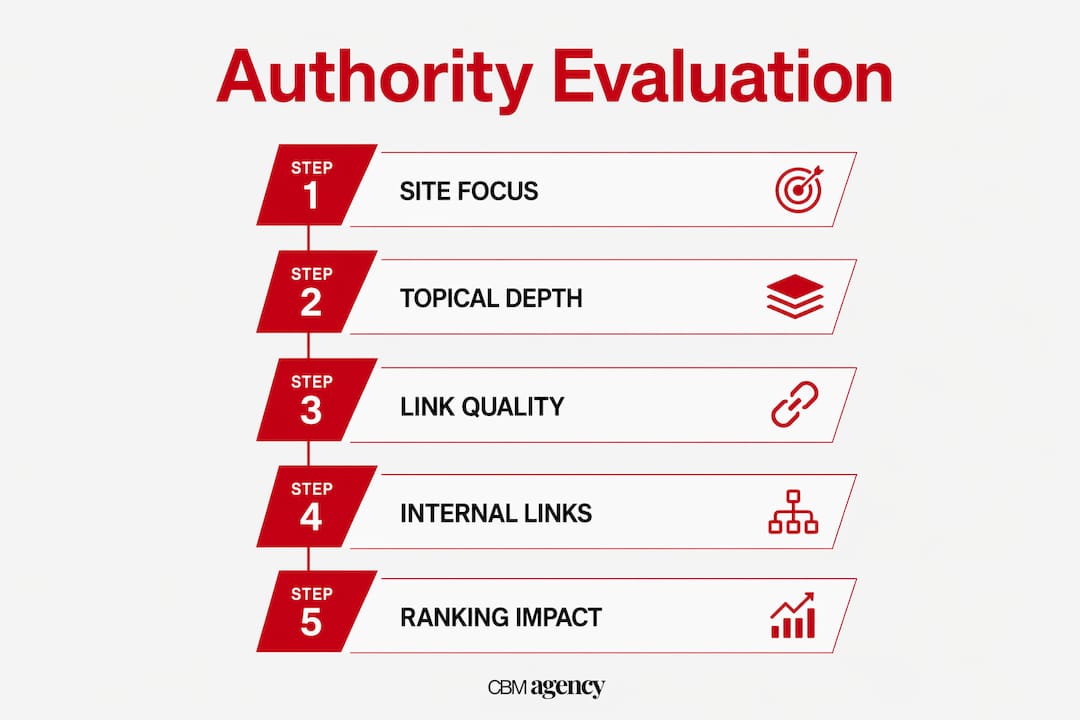
Google's evaluation includes what researchers describe as a site focus score, which measures how coherently a domain covers its subject area. It also uses topic embeddings to assess whether your content genuinely addresses a subject or just mentions keywords. Authority, trust, and relevance form a triad that Google uses to assess content quality and decide rankings. Remove any one of the three and the other two lose effectiveness.
The March 2026 core update made domain-level topical depth a primary ranking factor. 24% of tracked queries showed reshuffled rankings after the update, with deep topical cluster sites outperforming broad shallow content sites by roughly 3x in traffic. That is not a marginal shift. It represents a structural change in how Google rewards content investment.
The timeline of authority impact is also non-linear. Months 1 through 3 show little measurable change. Months 7 through 12 show strong compounding effects and increased algorithm resilience. This pattern catches many SEO professionals off guard because they expect linear returns and abandon the strategy before it pays off.
| Timeline phase | Typical activity | Expected outcome |
|---|---|---|
| Months 1–3 | Content cluster creation, internal linking | Minimal ranking movement |
| Months 4–6 | Backlink acquisition, cluster completion | Early visibility gains |
| Months 7–12 | Compounding authority, AI citation growth | Strong ranking improvements |
| Month 12+ | Algorithm resilience, sustained visibility | Durable competitive advantage |
Pro Tip: Track inputs, not just outputs. Measure topical cluster completion percentage, editorial backlinks earned, and internal link depth rather than fixating on Domain Authority scores. The inputs predict long-term success far better than the proxy metric does.
How do you build authority for SEO that actually compounds?
Building authority is not a single tactic. It is a system of connected decisions that reinforce each other over time. The following framework reflects what consistently works.
-
Build pillar content with topical clusters. A pillar page covers a broad topic comprehensively. Supporting spoke pages cover specific subtopics in depth. A cluster of 15 to 25 spoke pages around a single pillar generates compounding authority effects that Google's AI systems recognize within 6 to 9 months. Fewer spokes and the cluster loses coherence. More spokes without quality and the signal dilutes.
-
Create entity-rich content. Entities are named people, places, organizations, and concepts that Google can map to its knowledge graph. Knowledge graph alignment correlates at 89% with AI search visibility. Writing content that names and connects real entities is not just good writing. It is a direct input into how AI search surfaces your pages.
-
Earn editorial-grade backlinks. A link from a relevant, trusted publication carries far more weight than dozens of directory links. Focus on guest contributions, original research, and expert quotes that earn links naturally. Quantity without quality actively dilutes your authority signal.
-
Distribute authority through internal linking. Every time you publish a new page, link to it from existing high-authority pages on your site. This is how you pass authority to key pages that need ranking support. A well-linked internal structure multiplies the value of every external link you earn.
-
Build third-party proof. Reviews on Google Business Profile, mentions in industry publications, and citations in directories all contribute to brand authority. Google reads these signals as evidence that your business exists and is trusted beyond your own website.
-
Maintain a clear topical focus. Publishing content across too many unrelated topics fragments your authority signal. Topical authority acts as a performance ceiling rather than a linear weight. A scattered content strategy prevents you from reaching that ceiling in any subject area.
Pro Tip: The most common authority-building failure is not low quality. It is early abandonment. Most SEO failures trace back to insufficient topical cluster completion or stopping before the compounding effect kicks in. Commit to at least 60% cluster completion before evaluating results.
Why authority alone does not guarantee rankings
Authority is necessary but not sufficient. A site can have strong domain authority and still lose rankings to a less authoritative competitor with better relevance and trust signals. The three factors work together, not independently.
Google's E-E-A-T framework, which stands for Experience, Expertise, Authority, and Trustworthiness, reflects this reality. Authority covers one quarter of that framework. Verified organization schemas and sameAs references help Google confirm your identity and increase trust scores alongside authority. A business that publishes authoritative content but lacks verified schema markup leaves trust signals on the table.
AI-powered search adds another dimension. Voice queries and AI-generated answers favor content that is authoritative, specific, and structured. AI search visibility depends on topical authority combined with clear entity signals and trusted sourcing. Authority without those supporting elements rarely earns AI citations.
Practical integration points between authority and other SEO factors:
- Technical SEO: Fast load times and clean crawlability allow authority signals to reach Google efficiently. A technically broken site wastes the authority it earns.
- Content relevance: Authority amplifies relevance. A highly authoritative page on an irrelevant topic still ranks poorly for your target queries.
- User experience: Dwell time and engagement metrics signal to Google that your authoritative content is also useful. Authority without usability underperforms.
- Local signals: For service businesses, local citations and Google Business Profile completeness reinforce domain authority in local search results.
- Analytics and audits: Use tools like Google Search Console and regular SEO audits to track which pages are gaining authority traction and which clusters need more depth.
Key takeaways
Authority in SEO requires building topical depth, earning quality backlinks, and distributing link equity internally before rankings compound in months 7 through 12.
| Point | Details |
|---|---|
| Topical authority drives AI citations | Sites with deep topical coverage receive 267% more AI citations than shallow-content competitors. |
| Domain Authority scores are proxies | Google uses internal signals like topic embeddings, not Moz scores, to evaluate site authority. |
| Internal linking distributes authority | Strategic internal links free authority trapped on high-traffic pages and direct it to priority content. |
| Authority compounds after 7 months | Significant ranking gains appear in months 7 through 12; early abandonment is the top cause of failure. |
| E-E-A-T requires all four signals | Authority alone does not rank pages. Trust, relevance, and experience must accompany it. |
What I've learned about authority that most guides skip
The conversation about authority in SEO has matured significantly since the March 2026 update, but most practitioners are still treating it like a metric to chase rather than a system to build. I have watched businesses invest heavily in backlink acquisition while their content clusters sat at 30% completion. The links helped briefly. Then rankings stalled because Google could not confirm topical coherence.
The insight that changed how I think about this is that topical authority functions more like a ceiling than a ladder. You do not climb it incrementally. You either reach it within a subject area or you do not. That means scattered publishing is not just inefficient. It actively prevents you from ranking at your potential.
Patience is the real competitive advantage here. The 7 to 12 month compounding window is uncomfortable for clients and stakeholders who want monthly proof of progress. But the businesses that commit to the full cluster model and hold their topical focus are the ones that end up algorithm-resilient. Every core update since 2024 has rewarded them and penalized the shortcut-takers.
My recommendation is to stop measuring authority by proxy scores and start measuring it by cluster completion, entity coverage, and AI citation rate. Those inputs tell you whether you are building something durable or just moving numbers temporarily.
— Meshia
How Cbmagencymiami helps you build real search authority
Authority-building is not a side project. It is the foundation of every SEO strategy that produces durable results. Cbmagencymiami works with transportation and service businesses to build that foundation through topical content clusters, entity-rich publishing, and internal link architecture that distributes authority where it matters most. If your rankings have plateaued or you are invisible in AI-generated search results, the gap is almost always an authority gap. Explore Cbmagencymiami's SEO services in Miami to see how a structured authority strategy translates into more calls, more bookings, and stronger visibility across both Google and AI search. For businesses focused on AI-driven search, the AI search visibility program is built specifically around topical depth and knowledge graph alignment.
FAQ
What is the role of authority in SEO rankings?
Authority signals to Google that your site is a credible, expert source on a given topic. It combines with relevance and trust to determine where your pages rank in search results.
How does topical authority differ from domain authority?
Domain authority measures overall site strength based on backlinks and age. Topical authority measures how deeply and coherently your site covers a specific subject area, which is the stronger signal in 2026.
How long does it take to build SEO authority?
Authority investment shows minimal ranking change in months 1 through 3. Strong compounding effects typically appear between months 7 and 12 with consistent content and link-building effort.
Does Domain Authority from Moz directly affect Google rankings?
No. Moz's Domain Authority is a third-party proxy metric. Google uses its own internal signals including topic embeddings and link quality to evaluate site authority.
How do internal links affect SEO authority?
Internal links distribute authority from high-traffic pages to priority content across your site. Strategic internal linking is one of the fastest ways to improve rankings without acquiring new backlinks.