

Entities in SEO are defined as uniquely identifiable concepts, such as people, places, organizations, and products, that search engines recognize independently of the keywords used to describe them. Google no longer ranks pages based purely on keyword matches. By Q2 2026, search visibility depends on whether your brand, content, and topics are identified and connected within structured databases like Google's Knowledge Graph. Understanding the role of entities in SEO is no longer optional for marketers who want to show up in AI-generated answers, Knowledge Panels, and traditional organic results.
How do entities work in Google's Knowledge Graph?
Google's Knowledge Graph is the semantic backbone that connects entities and their relationships. When Google processes a query, it does not just match words. It identifies the entity behind the query and pulls structured data about that entity from its Knowledge Graph to serve the most accurate answer.

Entity disambiguation is the process Google uses to determine which specific entity a query refers to. For example, "Jaguar" could mean the car brand, the animal, or the NFL team. The Knowledge Graph resolves this by analyzing context, related entities, and structured data signals.
This shift has real consequences for how rankings work:
- Keyword signals tell Google what a page is about on the surface.
- Entity signals tell Google who or what the page represents at a deeper, factual level.
- Semantic relationships between entities determine topical authority, not just individual page relevance.
- AI models like Google Gemini and ChatGPT use entity data from the Knowledge Graph to generate direct answers, making entity inclusion critical for AI search visibility.
Knowledge Panels and Entity Carousels appear in search results when Google confidently identifies a clear entity behind a query. These SERP features give well-optimized entities significant visibility advantages over pages that rely on keywords alone. The practical implication is direct: if Google cannot identify your brand as a distinct entity, you will not appear in these high-visibility placements.
The shift from keyword-centric to entity-centric ranking signals also affects how you structure your entire content strategy. Pages that cover entity attributes, relationships, and context rank higher than pages focused on keyword strings. Linking over 30 related entities establishes topical dominance in a subject area. That is a concrete threshold worth building toward.
What are the key techniques for optimizing entities in SEO?
Entity optimization is not a one-time fix. Entity-first SEO strategies require consistent technical implementation over a minimum of three months, including schema markup and internal linking, before you see measurable improvements in AI search citations.
The foundation of entity optimization starts with these four steps:
- Create an entity home page. An authoritative entity home page acts as the primary source of truth for your brand or topic. It reduces ambiguity and helps Google disambiguate your entity from others with similar names. Think of it as your canonical identity page.
- Implement schema.org markup. Use structured data types including Organization, Person, Product, and Article to give Google machine-readable signals about your entities. Nest schema types to mirror real-world relationships between your brand, its founders, its services, and its locations.
- Build internal linking around entity relationships. Internal links between related pages reinforce semantic connections. A transportation company linking its fleet page, service area pages, and driver profile pages creates an entity web that Google can map and trust.
- Build a consistent data web. Entity optimization means creating a consistent set of data points about your brand, including owners, products, addresses, and authors, so search engines recognize it without ambiguity across the web.
Pro Tip: Entity salience matters more than mention volume. Place your primary entity in the H1, within the first paragraph, and in anchor text throughout the page. Google weights entity placement in high-impact structural locations far more than repeated mentions buried in body copy.
External corroboration also strengthens entity recognition. When authoritative third-party sites, such as industry directories, news outlets, and Wikipedia, mention your brand consistently, Google gains more confidence in your entity's identity. This is why PR and digital citations are now a direct SEO tactic, not just a brand awareness exercise.
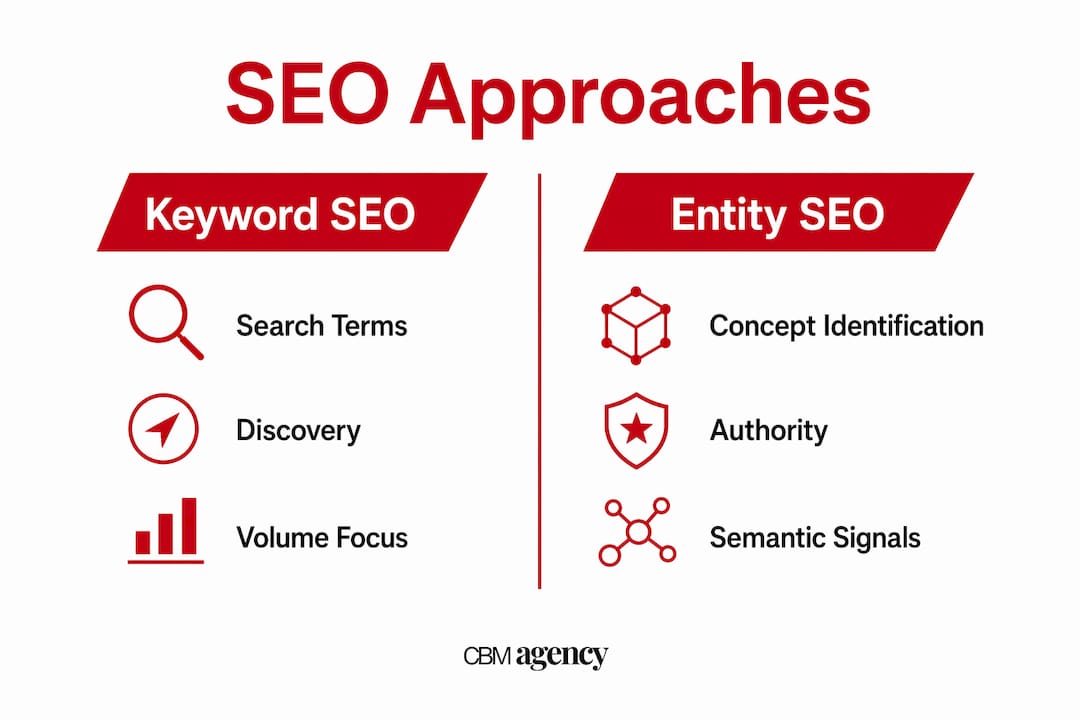
Entity SEO vs. traditional keyword SEO: what is the difference?
The two approaches are not opposites. Keywords still matter as discovery signals. Entities drive authority and AI visibility. The table below shows where they diverge.
| Criteria | Keyword SEO | Entity SEO |
|---|---|---|
| Primary focus | Matching search terms | Identifying concepts and relationships |
| Ranking signals | Backlinks, keyword density | Entity recognition, schema, topical authority |
| Content strategy | Target individual keywords | Build semantic clusters around entities |
| AI search visibility | Limited | High, through Knowledge Graph inclusion |
| Knowledge Panel eligibility | Not applicable | Direct pathway to Knowledge Panels |
| Topical authority | Built through keyword volume | Built by linking related entities |
Keywords remain the entry point for discovery. A user types "Miami airport car service" and Google matches that query to a page. But whether your page ranks above competitors depends on whether Google recognizes your brand as a trusted, well-defined entity in that space.
Entity-first SEO is the substrate for everything else in 2026. It underpins AI search layers and traditional organic results simultaneously. A business that invests in entity optimization gets compounding returns: better rankings, Knowledge Panel eligibility, and inclusion in AI-generated answers across Google, Perplexity, and ChatGPT.
Topical authority builds differently under entity SEO. Instead of targeting 50 keyword variations of the same topic, you map related entities and connect them through content and internal links. A transportation company that covers entities like "chauffeur service," "corporate travel," "airport transfers," and "fleet management" as distinct but linked concepts builds deeper authority than one that repeats a single keyword phrase across dozens of pages.
How to use entities to improve content strategy and rankings
Practical entity optimization starts with a mapping exercise. Before writing a single page, identify the core entities your brand needs to own. For a transportation business, that list includes the company itself, its service types, its service areas, its vehicles, and its key personnel.
From that map, build semantic clusters:
- Core entity page: Your entity home page covering who you are, what you do, and where you operate.
- Attribute pages: Individual pages for each service type, vehicle class, or location that link back to the core entity page.
- Relationship pages: Content that connects your entities to broader topics, such as corporate travel trends or airport logistics, to build contextual authority.
- Schema markup on every page: Apply the correct schema type to each page and nest related schema to show Google how your entities connect.
Measuring success in entity SEO looks different from traditional keyword tracking. Watch for Knowledge Panel appearances, inclusion in AI-generated answers, and improvements in local search rankings. These signals confirm that Google has recognized and resolved your entity.
Pro Tip: Use Google Search Console to monitor branded query impressions. A rising trend in branded searches often signals that Google has strengthened its entity association with your brand, even before a Knowledge Panel appears.
One important trade-off to understand: being part of the Knowledge Graph can reduce clicks on simple factual queries because Google answers them directly. The solution is to focus entity-optimized content on complex, multi-step topics that require a click to fully answer. For transportation businesses, that means content covering booking processes, fleet comparisons, and service area guides rather than simple FAQs that AI can answer in one sentence.
For a real-world example of how entity-first SEO applies to transportation, the pattern is consistent: businesses that structure their digital presence around clearly defined entities see stronger local rankings and more AI search citations than those relying on keyword-heavy content alone.
Key Takeaways
Entity optimization is the foundation of modern SEO, and businesses that build a clear, structured entity presence in Google's Knowledge Graph gain compounding advantages in both traditional rankings and AI-driven search visibility.
| Point | Details |
|---|---|
| Entities outrank keywords | Pages covering entity attributes and relationships rank higher than keyword-focused pages. |
| Entity home pages reduce ambiguity | A single authoritative page acting as the source of truth improves Google's entity resolution. |
| Schema markup is non-negotiable | Organization, Person, Product, and Article schema give Google machine-readable entity signals. |
| Topical authority needs 30+ entities | Linking over 30 related entities establishes dominance in a subject area. |
| AI visibility requires entity inclusion | Google Gemini and ChatGPT pull from the Knowledge Graph, so entity recognition drives AI citations. |
Why entity SEO changed how I think about rankings
I used to treat schema markup as a technical checkbox. Add it, move on. What changed my thinking was watching a transportation client gain a Knowledge Panel and start appearing in AI-generated answers for competitive queries, not because they published more content, but because we spent three months building a clean entity structure around their brand.
The uncomfortable truth about entity SEO is that most practitioners still treat it as a tactic layered on top of keyword strategy. It is not. Entity-first SEO is the foundation everything else sits on. If Google cannot confidently identify what your brand is, who owns it, where it operates, and what it does, no amount of keyword targeting will get you into AI-generated answers.
The hardest part is patience. Entity recognition takes time. Three months of consistent schema implementation, internal linking, and external citation building before you see Knowledge Graph inclusion. Most clients want results in 30 days. The ones who commit to the full process are the ones who end up owning their topic in both traditional and AI search.
My advice: start with your entity home page. Get that one page right before anything else. It is the anchor for everything Google learns about your brand.
— Meshia
How Cbmagencymiami helps you build entity authority
Cbmagencymiami works with transportation and service businesses to build the kind of structured entity presence that drives real search visibility. That means schema markup implementation, entity home page development, semantic cluster building, and external citation strategies designed to get your brand recognized in Google's Knowledge Graph and cited in AI-generated answers.
If you want to see what entity optimization looks like in practice, the AI search visibility results Cbmagencymiami has delivered for service businesses show exactly how this work translates into rankings, bookings, and revenue. For businesses ready to go deeper, the Google Maps case study demonstrates how entity and location optimization work together to dominate local search. Reach out to Cbmagencymiami to start building your entity foundation today.
FAQ
What is an entity in SEO?
An entity in SEO is any uniquely identifiable concept, such as a person, place, organization, or product, that search engines can recognize independently of the keywords used to describe it. Google uses entities to understand meaning rather than just match text.
How does the Knowledge Graph affect search rankings?
Google's Knowledge Graph connects entities and their relationships, allowing Google to rank content based on semantic authority rather than keyword density alone. Businesses with strong entity representation in the Knowledge Graph gain access to Knowledge Panels and AI-generated answer placements.
How long does entity optimization take to show results?
Entity-first SEO strategies require consistent implementation over a minimum of three months, including schema markup and internal linking, before measurable improvements in AI search citations appear.
What schema markup types matter most for entity SEO?
The most important schema types for entity optimization are Organization, Person, Product, and Article. Nesting these schema types to reflect real-world relationships between your brand and its attributes strengthens entity recognition.
Does entity SEO replace keyword SEO?
Entity SEO does not replace keyword SEO. Keywords remain the discovery signal that brings users to your content. Entities drive the authority and AI visibility that determine whether your content ranks above competitors and appears in AI-generated answers.