

Marketing a service business is not the same as selling a product. You cannot hand a potential client a sample or put your offering on a shelf. What you sell is an experience, a promise, and the people behind the work. That reality makes choosing among the many types of service business marketing more complex and more consequential than most business owners expect. Pick the wrong channels and you waste budget on audiences who will never convert. Pick the right ones and you build a pipeline that keeps growing. This guide cuts through the noise and gives you a practical framework for making that decision well.
Table of Contents
- Key Takeaways
- 1. Understanding what makes service business marketing different
- 2. Social media marketing for service visibility
- 3. Search engine optimization and local SEO
- 4. Search engine marketing and pay-per-click advertising
- 5. Email marketing and nurture campaigns
- 6. Content marketing and inbound strategy
- 7. Account-based marketing for B2B service businesses
- 8. Referral marketing as a high-ROI channel
- 9. Partner marketing and local collaborations
- 10. Public relations and reputation management
- 11. Direct mail and outbound advertising
- 12. Comparing marketing types: a practical guide for service businesses
- My honest take on picking the right marketing types
- How Cbmagencymiami turns service marketing into real bookings
- FAQ
Key Takeaways
| Point | Details |
|---|---|
| Services marketing is intangible | You must sell trust and experience, not a physical product, so channel and message selection matter more. |
| The 7Ps framework guides decisions | People, Process, and Physical Evidence are as important as price and promotion for service businesses. |
| Referral programs beat word of mouth | Structured referral systems generate 3x to 5x higher conversions than passive recommendations alone. |
| Digital and traditional channels both earn their place | Combining local SEO, social media, and relationship-based marketing produces stronger results than any single channel. |
| Measure repeatable demand, not just activity | Retention and utilization metrics reveal whether your marketing is actually building a healthy business. |
1. Understanding what makes service business marketing different
Services marketing focuses on increasing brand awareness and sales for businesses that deliver intangible experiences rather than physical goods. That distinction changes everything about how you communicate value.
When a client cannot see, touch, or test what you offer before buying, they rely on signals. Your reviews, your website, your response time, how your team presents itself on a call. Every one of those touchpoints is a marketing moment, whether you treat it that way or not.
The criteria below will help you evaluate which types of marketing suit your service business best:
- Audience fit: Are your buyers consumers or businesses? B2B buyers want data-backed messaging that solves specific problems. B2C buyers respond to emotional appeal and convenience.
- People, Process, and Physical Evidence: The 7Ps marketing mix adds these three elements to the classic four because service quality is delivered by people through processes, and clients judge you on visible evidence like your office, vehicle, or digital presence.
- Channel ROI and scalability: Some channels cost little but take time; others cost more but produce faster results. Match the channel to your growth stage.
- Customer experience consistency: The best service marketing strategy falls apart if the experience clients receive does not match what you promised.
Pro Tip: Before selecting any marketing channel, write one sentence describing your ideal client and the single biggest problem you solve for them. Every marketing decision you make should connect back to that sentence.
2. Social media marketing for service visibility
Social media is not just for product brands. For service businesses, it is one of the most direct ways to show your process, your team, and your results to people who do not yet know you exist.
Common marketing channels for service businesses include social media, search engine marketing, email marketing, content and inbound marketing, and partner or influencer programs. Social media sits near the top because it lowers the barrier between discovery and trust.
The most effective approach for service businesses is showing work in progress. A chauffeur company posting a time-lapse of a vehicle detail. A cleaning service sharing before-and-after photos. A consultant sharing a two-minute video on a problem their clients commonly face. These posts build familiarity, and familiarity builds bookings.

Influencer marketing pairs well here, especially for local service businesses. Partnering with a local content creator whose audience overlaps with yours is often more cost-effective than a paid ad campaign of the same reach.
3. Search engine optimization and local SEO
If someone in your city searches for the service you offer and you do not appear in the results, that business goes to a competitor. Local SEO is not optional for service businesses. It is the front door.
Local service marketing through Google depends on two things: your Google Business Profile and the content on your website. Both need to signal clearly what you do, where you do it, and why you are worth choosing. A well-optimized profile for transportation services can drive a consistent stream of calls and bookings without any paid spend.
SEO strategy for service businesses goes beyond keywords. It includes reviews, local citations, page speed, and structured data. Every piece of content you publish either strengthens or weakens your authority in Google's eyes.
Pro Tip: Target location-specific service pages, not just a generic homepage. "Executive car service in Miami" converts better than "car service" because the person searching it has already decided they want someone local.
4. Search engine marketing and pay-per-click advertising
Organic SEO builds authority over time. SEM and pay-per-click advertising produce results now. For new service businesses or those entering a competitive market, paid search is often the fastest way to put your name in front of buyers who are actively searching.
The key to service business advertising through paid search is bidding on intent-rich keywords. Someone searching "emergency HVAC repair tonight" or "book a notary near me" is ready to hire. That is exactly where your budget should go first.
Paid social ads work differently. They interrupt rather than capture intent. That means you need a compelling reason for someone to stop scrolling and consider your service. Strong creative and a clear offer matter far more here than they do in paid search.
5. Email marketing and nurture campaigns
Email marketing remains one of the highest-ROI channels available, and service businesses underuse it consistently. Most service providers collect client contact information and then do almost nothing with it.
A structured email program does three things. It keeps past clients thinking about you. It educates prospects who are not yet ready to book. It creates moments to ask for referrals and reviews. Those three functions alone make email worth building into your service business promotion strategy.
Segmentation is what separates good email marketing from spam. Personalization and segmentation dramatically improve campaign relevance and conversion rates in service marketing. A past client should receive a different message than a prospect who downloaded your guide but never scheduled a call.
6. Content marketing and inbound strategy
Content marketing is the practice of publishing material your ideal client finds useful before they are ready to buy. Done well, it positions you as the authority in your space and pulls qualified leads to you rather than requiring you to chase them.
For service businesses, content marketing works best when it addresses questions clients ask during the decision-making process. A staffing agency might publish a guide on what to look for in a temp-to-hire contract. A transportation company might explain how corporate ground transportation billing actually works.
This approach to local visibility through SEO takes longer than paid ads to produce results, but the leads it generates tend to be better qualified and more cost-effective over time.
7. Account-based marketing for B2B service businesses
Account-based marketing, or ABM, flips the typical funnel. Instead of casting wide and hoping the right clients find you, you identify specific high-value companies you want to work with and build campaigns designed just for them.
B2B service marketing uses targeting and personalization to reduce wasted spend and increase conversion by focusing on the accounts most likely to close. That might mean creating a custom case study referencing a prospect's industry, or sending a direct package to a decision-maker you have been trying to reach.
ABM is resource-intensive but produces outsized results when done with discipline. It works best for service businesses with high contract values, long sales cycles, and a clear ideal client profile.
8. Referral marketing as a high-ROI channel
Referral marketing is the one type of service business marketing that almost every business owner says they rely on but very few actually build a system around. There is a significant difference between hoping for referrals and creating a program that generates them predictably.
Referral programs generate 3x to 5x higher conversion rates and reduce customer acquisition costs by 25% to 40% for service businesses. The trust embedded in a personal recommendation does the selling before the prospect ever contacts you.
Automated referral systems that include a structured ask, clear tracking, and meaningful rewards significantly outperform ad hoc word-of-mouth approaches. The ask matters most. Clients who had a great experience will refer if you make it easy and give them a reason to do so right now.
The practical steps are simple: identify your best clients, reach out personally, offer a reward that reflects the value of what they send you, and track everything with a basic CRM or referral tool.
9. Partner marketing and local collaborations
Partner marketing means working with complementary businesses to share audiences and generate leads. A wedding photographer and a wedding car service share almost the same client at the same moment in time. A corporate hotel and an executive transportation provider are natural partners.
These relationships cost little compared to paid advertising and carry built-in trust because the referral comes from a business the prospect already hired. Local event marketing fits into this category too. Sponsoring or participating in community events puts your brand in front of an engaged, local audience.
The most effective partner arrangements involve a genuine two-way exchange. You refer clients to them; they refer clients to you. Formalizing that exchange with agreed processes and consistent follow-up turns a casual relationship into a reliable source of new business.
10. Public relations and reputation management
PR for service businesses is not just about press releases. It is the ongoing management of how your business is perceived by everyone who might influence your clients. That includes journalists, review platforms, local business associations, and online communities.
A single piece of coverage in a local business publication can generate more credibility than months of advertising. A profile on a trusted industry site signals authority to both clients and search engines.
Reputation management means treating your Google and Yelp reviews as seriously as your paid campaigns. One unresolved negative review seen by a hundred potential clients is a marketing problem, not just a service issue.
11. Direct mail and outbound advertising
Direct mail has made a quiet comeback because digital inboxes are saturated and physical mail gets attention. For local service businesses targeting specific neighborhoods or industries, a well-designed mailer sent to the right list can generate strong returns.
Outbound advertising, including print, radio, and targeted digital display, works best as a brand awareness tool rather than a direct conversion channel for most service businesses. The goal is repeated exposure so that when a prospect is ready to hire, your name is the first one they think of.
These channels suit businesses with established revenue and a need to scale reach in specific markets. They are rarely the right starting point for a new service business with a limited budget.
12. Comparing marketing types: a practical guide for service businesses
Choosing among service marketing strategies comes down to three factors: your budget, your sales cycle, and your ideal client type. This table gives you a clear starting point.
| Marketing Type | Best For | Typical Cost | Time to Results | Scalability |
|---|---|---|---|---|
| Local SEO | Local service businesses | Low to medium | 3 to 6 months | High |
| Paid search (SEM/PPC) | High-intent lead capture | Medium to high | Immediate | High |
| Email marketing | Retention and nurture | Low | 30 to 90 days | High |
| Referral programs | Trust-based growth | Low | 30 to 60 days | Medium |
| Content marketing | Authority and inbound leads | Medium | 6 to 12 months | High |
| Social media | Brand awareness and engagement | Low to medium | 30 to 90 days | High |
| ABM | High-value B2B accounts | High | 60 to 120 days | Low to medium |
| Partner marketing | Community and referral leads | Low | 30 to 90 days | Medium |
| Direct mail | Local awareness and reach | Medium | 2 to 6 weeks | Medium |
Pro Tip: Start with one channel you can own well before adding another. A service business with a great referral program and strong local SEO will consistently outperform one running five mediocre campaigns at once.
My honest take on picking the right marketing types
I have worked with service businesses at every stage, from solo operators trying to book their first ten clients to established companies with a marketing budget and no clear strategy. The pattern I keep seeing is the same: they choose channels before they understand what they are actually selling.
Here is what I have learned. The 7Ps that shape customer experience matter more than any channel you pick. If your team does not answer the phone well, no amount of Google Ads will fix your conversion rate. If your process is confusing to clients, your email marketing will generate unsubscribes. Channel decisions are tactical. People, Process, and Physical Evidence are foundational.
I have also seen too many service businesses treat referral marketing as something that just happens. It does not. When you build a system around it, something changes. You stop feeling like you are always chasing leads and start feeling like the business is pulling itself forward.
My other conviction is about measurement. Most service businesses track how busy they are. Very few track whether that busyness is profitable and repeatable. Meaningful growth metrics focus on retention, utilization, and repeatable demand, not just how many calls came in this week. When you measure the right things, your marketing decisions get much clearer.
— Meshia
How Cbmagencymiami turns service marketing into real bookings
If you are a service business that wants more calls, more bookings, and real growth from search, Cbmagencymiami builds exactly that.
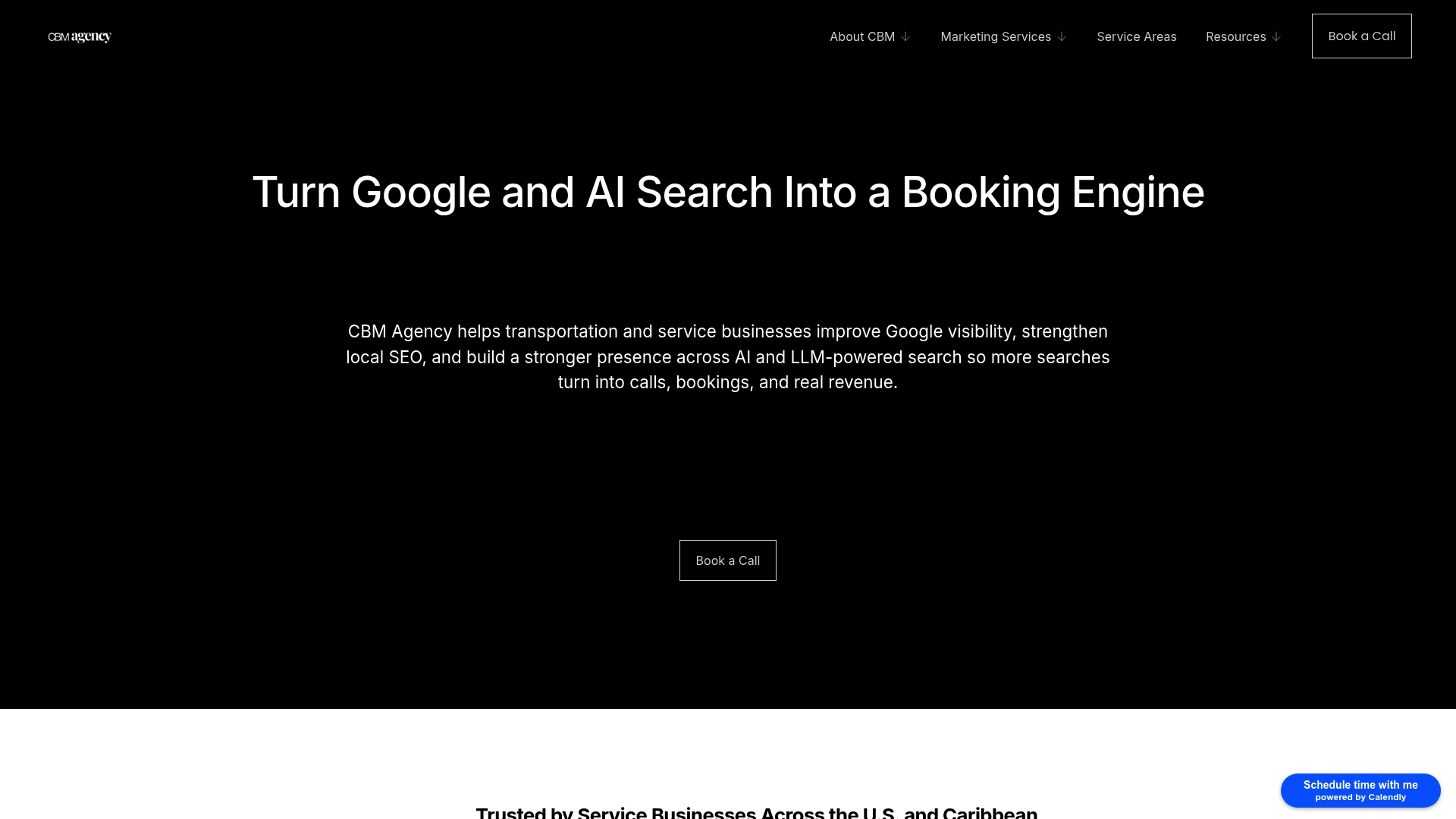
Cbmagencymiami specializes in helping transportation and service businesses rank on Google Maps, improve local SEO, and build visibility across AI-powered search. The work is practical and measurable. You can see what a targeted local strategy actually produces in the Google Maps case study for service businesses. If you want your Google Business Profile working as a booking engine instead of a digital brochure, this is the place to start. Every search that finds you is revenue that does not have to be chased.
FAQ
What are the main types of service business marketing?
The main types include local SEO, social media marketing, email marketing, referral programs, content marketing, paid search, and partner or PR marketing. Each serves a different stage of the client acquisition process.
Why is local SEO critical for service businesses?
Local SEO determines whether potential clients find you when they search for services in your area. Without it, your competitors capture that search traffic instead of you.
How does referral marketing compare to paid advertising for service businesses?
Referral marketing generates 3x to 5x higher conversion rates than most paid channels and reduces acquisition costs by 25% to 40%, making it one of the highest-ROI options available to service businesses.
What is the 7Ps framework and why does it matter for service marketing?
The 7Ps marketing mix adds People, Process, and Physical Evidence to the original four Ps. These three additions reflect the reality that in service businesses, how you deliver matters as much as what you promote.
How do I choose between digital and traditional marketing for my service business?
Start by identifying where your ideal clients look when they need your service. Most service businesses see the best results by combining local SEO and email marketing with at least one relationship-based channel like referrals or partnerships.