

Local search is defined as the process by which Google and AI-powered platforms connect customers actively searching for nearby services with the businesses best positioned to serve them. For transportation companies, service providers, and any business that depends on local customers, this is not a background marketing function. It is the front door. When your Google Business Profile is optimized, your citations are consistent, and your content speaks to specific neighborhoods and services, AI systems gain the confidence to recommend you over competitors. That confidence translates directly into direction clicks, phone calls, and bookings.
Why local search matters more than ever in 2026
The importance of local search has shifted from simply appearing in results to being chosen by AI systems on behalf of the customer. Google's AI-powered search features, including AI Overviews and conversational discovery tools, now mediate how customers find and select local businesses. This means your visibility depends less on keyword stuffing and more on whether structured data, reviews, and listing accuracy give AI enough trust signals to recommend you confidently.
AI now mediates local business discovery based on data quality, review recency, engagement signals, and real-world factors like proximity and availability. A transportation company with a fully optimized Google Business Profile, accurate citations across directories, and recent five-star reviews is far more likely to appear in an AI-generated recommendation than a competitor with a stale listing and no review activity.
Here is what the 2026 data shows about how customers actually behave after a local search:
- Direction clicks rose 6.4% year-over-year, even as local listing visibility dropped 13.2%. Fewer impressions, but stronger offline intent from the customers who do find you.
- Phone clicks fell 12.9% and website clicks fell 7.7%, confirming that customers are moving straight from search to physical action.
- Healthcare direction clicks grew 10.2%, while hospitality bookings dropped 53.5%, showing that industry-specific local dynamics vary dramatically.
- Zero-click discovery is rising. Customers get answers directly from AI without visiting your website at all.
Pro Tip: If your Google Business Profile still lists an old phone number or a service area that does not match your actual coverage, AI systems will deprioritize you. Audit your profile today before investing in any other local search strategy.
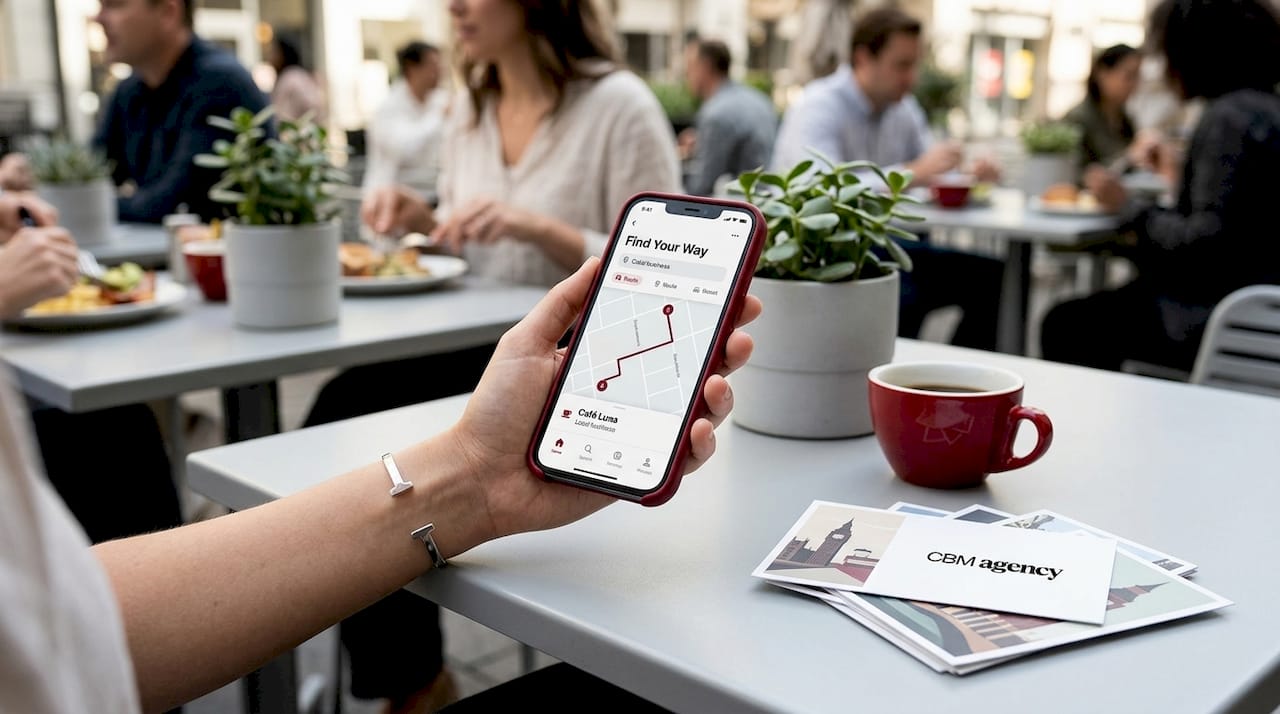
The shift toward direction clicks is not a minor trend. It signals that local search now functions as a booking engine, not a brochure. Customers who find you through local search are already committed to acting. Your job is to make sure AI systems trust your data enough to surface you in the first place.
What trust signals actually influence local search performance
Local search performance is determined by a combination of on-profile accuracy, off-site authority, and content specificity. Most business owners focus on one of these and neglect the others. That imbalance is exactly why many businesses rank for generic terms but fail to convert local customers.
-
Listing accuracy across all platforms. Your business name, address, and phone number must be identical on Google Business Profile, Yelp, Apple Maps, Bing Places, and every industry directory. A single inconsistency signals unreliability to AI systems and suppresses your recommendations.
-
Review recency and volume. Fresh reviews carry more weight than a high average rating built years ago. A transportation company with 12 reviews from the past 30 days outperforms a competitor with 200 reviews from 2022. Consistent GBP engagement including photos, updates, and review responses signals trust and freshness to Google's ranking systems.
-
Neighborhood and service-specific content. Vague location pages that say "we serve the Miami area" do not build AI confidence. Hyperlocal content that names specific neighborhoods, describes exact services, and provides clear next steps converts far better and ranks more reliably.
-
Structured data with correct schema. Using the wrong schema type or omitting sameAs links in your structured data actively penalizes your local search trust. Correct schema and sameAs chains give AI systems a verified, machine-readable identity for your business.
-
Off-site citation authority. Content alone does not build AI confidence. Businesses below roughly 50 independent brand mentions across credible external sources struggle to be cited or recommended by language models. Citation building is not optional. It is foundational.
Pro Tip: Do not treat your Google Business Profile as a one-time setup task. Think of it as a living asset. Schedule monthly updates, add new photos after every significant job or event, and respond to every review within 48 hours. This cadence signals active operation to both Google and AI systems.
How to measure local search success the right way
Rankings are not the right measure of local search success. A business can rank in position three for "limo service Miami" and still lose customers to a competitor in position five who has better reviews, more accurate hours, and a stronger direction-click rate. The real measure of local search impact is what customers do after they find you.
The table below shows which metrics actually reflect local search performance versus which ones mislead you.
| Metric | What it actually tells you |
|---|---|
| Direction clicks | Customers intend to visit your physical location. This is the strongest offline-intent signal available. |
| Phone calls from GBP | Direct contact from a high-intent prospect. Declining industry-wide, but still valuable for service businesses. |
| Website clicks from GBP | Moderate intent. Useful for tracking, but falling across most sectors in 2026. |
| Keyword ranking position | Visibility proxy only. Does not reflect whether customers take action. |
| Review response rate | Signals operational engagement. Influences AI trust and future customer confidence. |
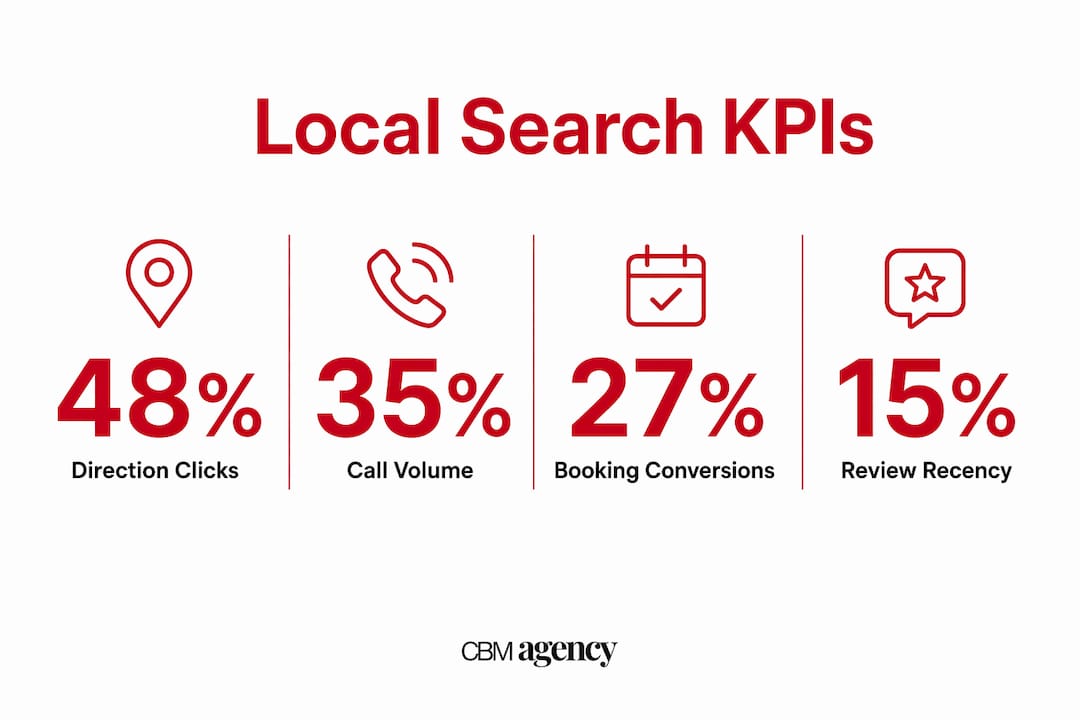
Location-level data monitoring is the standard that separates businesses that grow from those that plateau. If you operate multiple locations or service areas, brand-level averages hide the truth. One underperforming location can drag down your entire local search strategy without appearing in aggregated reports.
The practical takeaway is this: track direction clicks, call volume, and booking conversions at the individual location level every month. Compare those numbers against review activity and profile update frequency. When direction clicks drop, the cause is almost always a data accuracy issue, a review gap, or a content problem. Each of those is fixable.
Practical strategies to strengthen your local search presence
Improving your local search presence does not require a complete website overhaul. It requires disciplined execution across a focused set of activities. Here is what actually moves the needle.
- Optimize your Google Business Profile completely. Fill every field: business category, service areas, hours, photos, products, and service descriptions. An incomplete profile is a missed opportunity. Read the full GBP setup guide to make sure nothing is missing.
- Build and maintain local citations. Submit your business to Google, Bing Places, Apple Maps, Yelp, and at least 20 industry-relevant directories. Use a tool like BrightLocal or Whitespark to audit existing citations for inconsistencies before adding new ones.
- Publish neighborhood-specific and service-specific content. Write dedicated pages or blog posts for each major service area and service type. "Airport transfers in Coral Gables" performs better than "Miami transportation services" because it matches the exact query of a high-intent customer.
- Build a review acquisition system. Do not wait for reviews to come in organically. After every completed job, send a follow-up message with a direct link to your Google review page. Learn how to improve local reviews consistently without violating Google's guidelines.
- Implement structured data correctly. Add LocalBusiness schema to every location page. Include sameAs properties linking to your Google Business Profile, Yelp listing, and other authoritative sources. Validate your schema using Google's Rich Results Test before publishing.
- Monitor and respond to every review. Responding to reviews, both positive and negative, signals to Google that your business is active and customer-focused. This engagement factor directly influences your local search ranking and AI recommendation likelihood.
The businesses that win at local search in 2026 are not the ones with the biggest budgets. They are the ones with the most accurate, consistent, and actively maintained local data across every platform where customers search.
Key takeaways
Local search success in 2026 depends on AI trust signals, not just rankings, making data accuracy, citation consistency, and review recency the primary drivers of visibility and customer action.
| Point | Details |
|---|---|
| AI mediates local discovery | Structured data, reviews, and listing accuracy determine whether AI recommends your business. |
| Direction clicks are the top metric | Direction clicks rose 6.4% in 2025, making them the clearest signal of offline customer intent. |
| Citation authority is non-negotiable | Businesses with fewer than 50 independent brand mentions struggle to appear in AI-generated recommendations. |
| Measure at the location level | Brand-level averages hide underperforming locations. Track direction clicks and calls per location monthly. |
| Content must be hyperlocal | Neighborhood and service-specific pages convert better and build stronger AI trust than generic location pages. |
Why I think most businesses are solving the wrong local search problem
I have worked with transportation and service businesses long enough to see the same mistake repeat itself. A business owner invests in a new website, publishes a few blog posts, and then wonders why the phone is not ringing. The answer is almost always the same: the local data infrastructure is broken. The Google Business Profile has not been touched in two years. The citations are inconsistent across directories. There are no recent reviews. And the structured data is either missing or wrong.
The shift I find most significant is this: local SEO used to be about presence. You showed up, you ranked, customers called. Now it is about being chosen by AI on behalf of the customer. That is a fundamentally different challenge. It requires treating your local data as a living operational asset, not a marketing checkbox.
What I see working right now is operational rigor. Businesses that update their profiles monthly, respond to every review, and publish content that names specific neighborhoods and services are outperforming competitors with larger budgets and fancier websites. The advantage of local search today belongs to the businesses that take data governance seriously.
My honest advice: stop chasing rankings and start auditing your trust signals. Check your citations for inconsistencies. Look at your direction click trends, not your keyword positions. Ask yourself when you last added a photo to your Google Business Profile. Those unglamorous tasks are what separate businesses that grow from those that stay invisible.
— Meshia
How Cbmagencymiami helps you win at local search
Cbmagencymiami works specifically with transportation and service businesses that need more than generic SEO advice. The team manages Google Business Profiles from the ground up, builds citation networks that AI systems trust, and creates hyperlocal content that turns searches into bookings.
If your direction clicks are flat, your reviews are stale, or your listings are inconsistent across platforms, those are solvable problems. The Google Maps case study on the Cbmagencymiami website shows exactly how service businesses have improved local visibility and customer engagement through structured, data-driven optimization. For businesses ready to build a stronger presence in AI-powered search, the AI search visibility service is built for exactly that challenge. Reach out to Cbmagencymiami to get a tailored local search strategy for your market.
FAQ
What is the importance of local search for small businesses?
Local search connects your business with nearby customers who are actively ready to buy or book. It drives direction clicks, calls, and in-person visits from high-intent prospects who already know what they need.
How does AI change local search in 2026?
AI now selects and recommends local businesses based on data trust signals including listing accuracy, review recency, and structured data quality. Appearing in results is no longer enough. Your data must give AI the confidence to recommend you.
What metrics should I track for local search success?
Track direction clicks, phone calls, and booking conversions at the individual location level. Direction clicks increased 6.4% in 2025 while phone and website clicks declined, making them the most reliable indicator of local search performance.
How many citations does a business need to rank in local search?
Businesses with fewer than roughly 50 independent brand mentions across credible external sources struggle to be cited or recommended by AI-powered search tools. Citation building across directories, news sites, and industry platforms is a baseline requirement.
How often should I update my Google Business Profile?
Update your Google Business Profile at least once a month with new photos, service updates, or posts. Consistent GBP activity signals operational trust to Google and improves your likelihood of appearing in AI-generated local recommendations.