

If you run a service business and your phone isn't ringing from Google searches, the problem might not be your website. It might be that Google doesn't know where you are or who you're trying to reach. What is location-based SEO? It's the practice of optimizing your online presence so your business shows up when people search for services in a specific area. Unlike general SEO, it targets physical proximity, local relevance, and community trust signals. For transportation companies, contractors, and service providers, it's the difference between a fully booked schedule and a fleet that stays parked.
Table of Contents
- Key takeaways
- What is location-based SEO and how it works
- Core local SEO strategies that actually move the needle
- How location data and technology sharpen local targeting
- Common pitfalls and how to measure what's working
- Location-based SEO in practice for service businesses
- My take on why local SEO is the most underrated growth lever
- See what strong local SEO actually looks like in practice
- FAQ
Key takeaways
| Point | Details |
|---|---|
| Location changes how Google ranks you | Google uses proximity, relevance, and prominence to decide who shows in local results. |
| Google Business Profile is your front door | A complete, optimized GBP is the single highest-impact move for local visibility. |
| NAP consistency is non-negotiable | Inconsistent name, address, and phone data can cut your local citations by 30 to 50%. |
| Mobile drives local search | More than 70% of local searches happen on mobile, so a slow site costs you real bookings. |
| AI is reshaping local rankings | Schema markup, reviews, and citations now feed AI-powered search recommendations directly. |
What is location-based SEO and how it works
Location-based SEO is a discipline within search engine optimization focused on making your business visible to people searching in a specific geographic area. Think of it as traditional SEO with a physical address attached. When someone in Miami types "corporate car service near me," Google doesn't return the most authoritative website on the internet. It returns the most relevant, nearby, and trusted option available at that moment.
That's a fundamental shift from how general SEO works. Organic SEO rewards domain authority, backlink volume, and content depth. Local SEO rewards a completely different set of signals, and Google's three local ranking factors are proximity, relevance, and prominence. Here's what each one actually means for your business:
- Proximity: How close your business is to the searcher's location at the time of the query
- Relevance: How well your business profile, website, and content match what the searcher is looking for
- Prominence: How well-known and trusted your business is online, measured through reviews, citations, and backlinks
These three factors determine whether you land in the Map Pack. That top three block of local listings consistently outperforms the number one organic result in click-through rate. Most clicks on local queries go to those three listings. If you're not in that pack, you're largely invisible to the customers who matter most.
Your Google Business Profile (GBP) is the starting point for all of this. It signals your location, your category, your hours, your services, and your reputation to Google in a structured format. Without a complete and optimized GBP, proximity alone won't save you.
Pro Tip: Set your GBP service area to include surrounding neighborhoods and cities where you actually operate, not just your registered address. This expands your proximity footprint without misleading anyone.
Core local SEO strategies that actually move the needle
Knowing what location-based SEO is gets you oriented. Knowing what to do about it gets you results. Here are the strategies that drive the most impact for service businesses, in order of priority:
-
Optimize your Google Business Profile completely. Fill in every field: business category, service areas, hours, photos, services, and a description with your primary keywords. Check out the GBP setup guide for a step-by-step breakdown. An incomplete profile signals neglect to both Google and potential customers.
-
Lock down your NAP consistency. Your business name, address, and phone number must be identical across your website, GBP, Yelp, Apple Maps, industry directories, and every other listing. Inconsistent NAP leads to 30 to 50% fewer local citations because AI systems start questioning whether your business is legitimate.
-
Create location-specific pages on your website. If you serve Miami, Coral Gables, and Brickell, each of those areas deserves its own landing page with unique content. Not copy-pasted pages with the city name swapped out. Real content about what you do there, who you serve, and what makes that area relevant.
-
Ask for reviews and respond to every one. Businesses with 50 or more reviews averaging 4.0 stars or higher see two to three times more AI-driven local recommendations. Respond to negative reviews professionally. Silence on a bad review signals indifference.
-
Build local backlinks. Sponsorships, local press mentions, chamber of commerce memberships, and guest posts on neighborhood blogs all count. A link from a Miami-based news outlet carries far more local weight than a generic directory.
-
Prioritize mobile speed. Over 70% of local searches happen on mobile devices. If your site loads slowly on a phone, you're losing bookings before the page even opens. Read the mobile SEO guide for specifics on what to fix.
-
Add LocalBusiness schema markup. This structured data tells Google and AI systems exactly what your business is, where it is, and what it offers. Businesses with complete schema markup earn 40 to 60% more local citations and up to five times more AI recommendations.
Pro Tip: Use Google's free Business Profile posts weekly. They signal active management and give Google fresh content to index, which helps with relevance scoring.
How location data and technology sharpen local targeting
Understanding the importance of local SEO goes deeper than search rankings. Modern location-based marketing layers technology on top of search to create hyper-relevant experiences at exactly the right moment. This is where local SEO and location-based marketing converge.
Your phone is constantly broadcasting signals. GPS, Wi-Fi connections, and Bluetooth beacons all feed location data to apps, advertisers, and search engines. When Google sees consistent location signals tied to your business, it builds confidence in your relevance for nearby queries. That's why claiming your GBP, embedding a Google Map on your contact page, and using geo-tagged photos all matter. They each add a data point that reinforces your physical location.
Geo-targeting and geofencing take this further. Geo-targeting and geofencing allow marketers to trigger timely messages based on where someone physically is. A transportation company can serve ads to people entering Miami International Airport. A contractor can target homeowners within a two-mile radius of a completed project. These tools complement your organic local SEO by reinforcing your name in the locations where you want to win.

Here's the number that shows how much this matters commercially: advertisers spent $57 billion on location-targeted ads in 2025 alone, and nearly 90% of consumers prefer ads personalized to their location. Location has become the most powerful personalization signal available to marketers.
AI search is also changing the game. Google's AI Overviews and tools like ChatGPT now synthesize multiple local signals before making recommendations. AI-driven local search integrates schema data, citation consistency, review volume, and user location into a single recommendation. If any piece of your local foundation is weak, the AI drops you from consideration.
"Location-based marketing strategies that use real-time location data increase conversion rates by up to 27% by delivering hyper-relevant messages at the moment a customer is most receptive."
Common pitfalls and how to measure what's working
Most businesses don't fail at local SEO because the strategies are too complicated. They fail because of basic execution gaps that compound over time. Here's what to watch out for:
- Duplicate location pages: Multiple pages targeting the same city with near-identical content confuse Google and dilute your authority. Each location page needs genuinely unique content.
- Ignoring the GBP Q&A section: Competitors or strangers can post questions on your profile. If you don't answer them, someone else will. Or no one will, which looks equally bad.
- Inconsistent citations after a move or rebrand: Changing your address or phone number? Update every directory immediately. Stale data on even a few major platforms can undermine months of work.
- Zero mobile optimization: A beautiful desktop website that loads slowly on a phone is a conversion killer for local search.
- Buying fake reviews: Google's detection has improved significantly. The penalty is not worth the short-term boost.
For tracking, focus on these metrics:
- Map Pack ranking position for your primary keywords (use tools like BrightLocal or Whitespark)
- Local search impressions inside GBP Insights
- Website clicks from GBP listings
- Review rating and total review volume month over month
- Citation consistency score (BrightLocal's audit tool is reliable)
Pro Tip: Run a full SEO audit every quarter, not just when rankings drop. Problems are much cheaper to fix early than after months of compounding damage.
Location-based SEO in practice for service businesses
The theory is clear. Here's what it looks like when a service business actually executes well.
A transportation company serving South Florida creates individual landing pages for Miami, Fort Lauderdale, and Boca Raton. Each page references local landmarks, common travel routes like the I-95 corridor, and client testimonials from that specific area. Localized content that references neighborhoods, events, and testimonials creates differentiation that both Google and AI systems favor for local queries.
The same business embeds Google Maps on each location page, includes the local phone number in the header, and lists local schema markup specifying the service area. Customers leaving reviews mention specific neighborhoods like Wynwood or Brickell. Those neighborhood mentions in reviews act as organic relevance signals that no paid campaign can replicate.
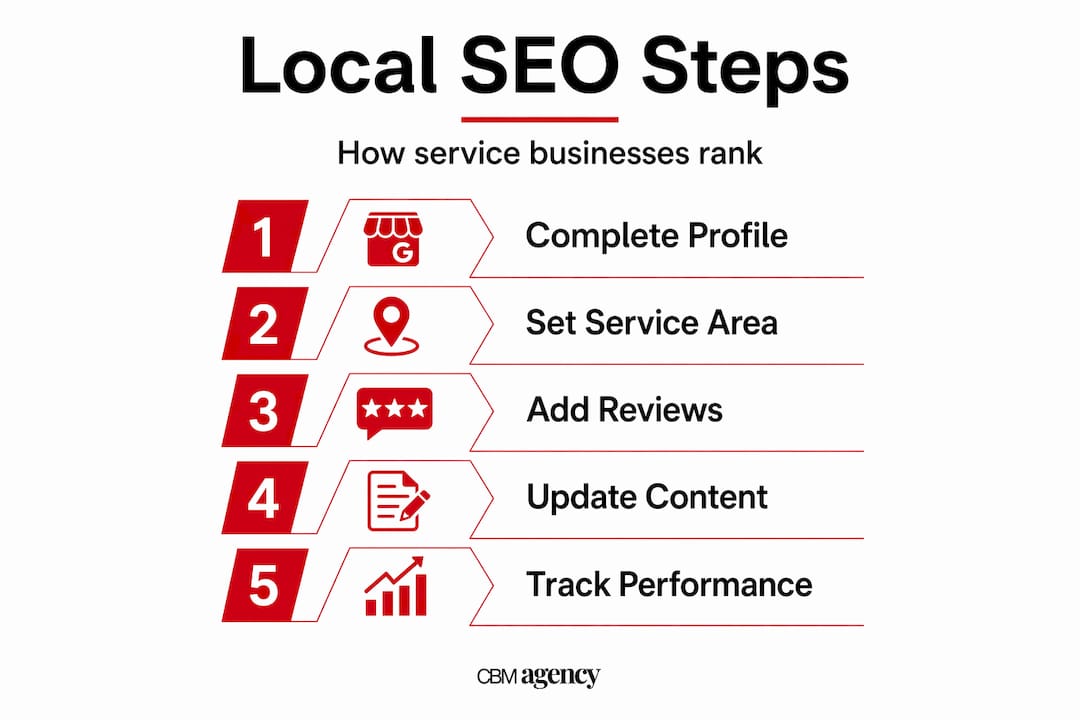
Here's a quick comparison of what separates businesses that dominate local search from those that stay invisible:
| What winning businesses do | What struggling businesses do |
|---|---|
| Fully completed GBP with photos and posts | Minimal GBP with no recent activity |
| Consistent NAP across 20+ directories | NAP differs on Google, Yelp, and the website |
| 50+ reviews averaging 4.2 stars | Under 10 reviews with no responses |
| Location-specific landing pages | One generic "Contact Us" page |
| LocalBusiness schema on every location page | No schema markup at all |
| Mobile-optimized site loading under 2 seconds | Desktop-first design loading over 4 seconds |
The gap between these two columns is not technical complexity. It's attention and consistency. A solid local SEO strategy executed consistently beats a theoretically perfect strategy implemented halfway.
My take on why local SEO is the most underrated growth lever
I've worked with service businesses across transportation, hospitality, and professional services, and the pattern is consistent. The businesses investing in national brand awareness while ignoring local SEO fundamentals are the same ones confused about why their competitors with simpler websites are getting more calls.
Here's what I've found counterintuitive about how location affects SEO: proximity can outweigh domain authority in local results. A newer business with 80 well-optimized reviews, a complete GBP, and consistent NAP can outrank an established competitor with ten times the backlinks. That's rare in organic SEO. In local SEO, it happens regularly.
What I've learned from watching Google's local algorithm evolve is that AI integration is accelerating, not slowing. The businesses that build strong local foundations now — schema, reviews, citations, mobile speed — are compounding advantages that will be very hard for late movers to overcome. The future of location-based marketing isn't just about showing up in the Map Pack. It's about being recommended by AI assistants, voice search, and zero-click experiences. All of those feed from the same local SEO signals you should be building today.
My honest take: most businesses treat local SEO as a one-time setup task. The ones winning treat it as an ongoing practice. That mindset shift is worth more than any single tactic.
— Meshia
See what strong local SEO actually looks like in practice
If you want proof that consistent local SEO work translates into real bookings, not just rankings, start with CBM Agency's Google Maps case study. It shows exactly how service businesses move from invisible to the top of local results through GBP optimization, citation management, and localized content.
Cbmagencymiami works specifically with transportation and service businesses to build the kind of local presence that turns searches into calls. From Google Business Profile management to AI search visibility and full local SEO campaigns, every service is built around getting your business in front of the people already looking for what you offer. If you're ready to stop guessing and start showing up, reach out for a consultation.
FAQ
What is location-based SEO in simple terms?
Location-based SEO is the process of optimizing your business's online presence to rank in search results for queries tied to a specific geographic area. It includes your Google Business Profile, local citations, reviews, and location-specific website content.
How does location affect SEO rankings?
Google uses proximity, relevance, and prominence to determine local rankings. Proximity is how close your business is to the searcher. Relevance is how well your profile matches the search. Prominence reflects your reputation through reviews, citations, and backlinks.
Why is local SEO important for service businesses?
The Map Pack consistently earns higher click-through rates than the top organic result, making local visibility directly tied to leads and bookings. For service businesses, ranking locally means more calls from customers who are ready to hire.
How many reviews do I need for local SEO to work?
Businesses with 50 or more reviews averaging 4.0 stars or higher see two to three times more AI-driven local recommendations. The number matters, but so does recency and your response rate.
What's the difference between geo-targeting and geofencing?
Geo-targeting delivers content or ads to users in a defined region based on their IP address or device data. Geofencing creates a virtual boundary that triggers a message when someone physically enters or exits that area. Both complement local SEO by reinforcing your brand in specific locations.