

Local SEO competitor analysis is the practice of systematically evaluating your online rivals' Google Business Profiles, keyword rankings, backlinks, and reputation signals to find gaps you can exploit. For small and mid-sized transportation businesses, knowing how to analyze competitors for local SEO is the difference between showing up when a customer searches "black car service near me" and watching a rival take that booking. The goal is not to copy what others do. The goal is to understand why they rank, where they fall short, and what you can do better. Tools like Semrush, Ahrefs, BrightLocal, and Google Business Profile are your starting points.
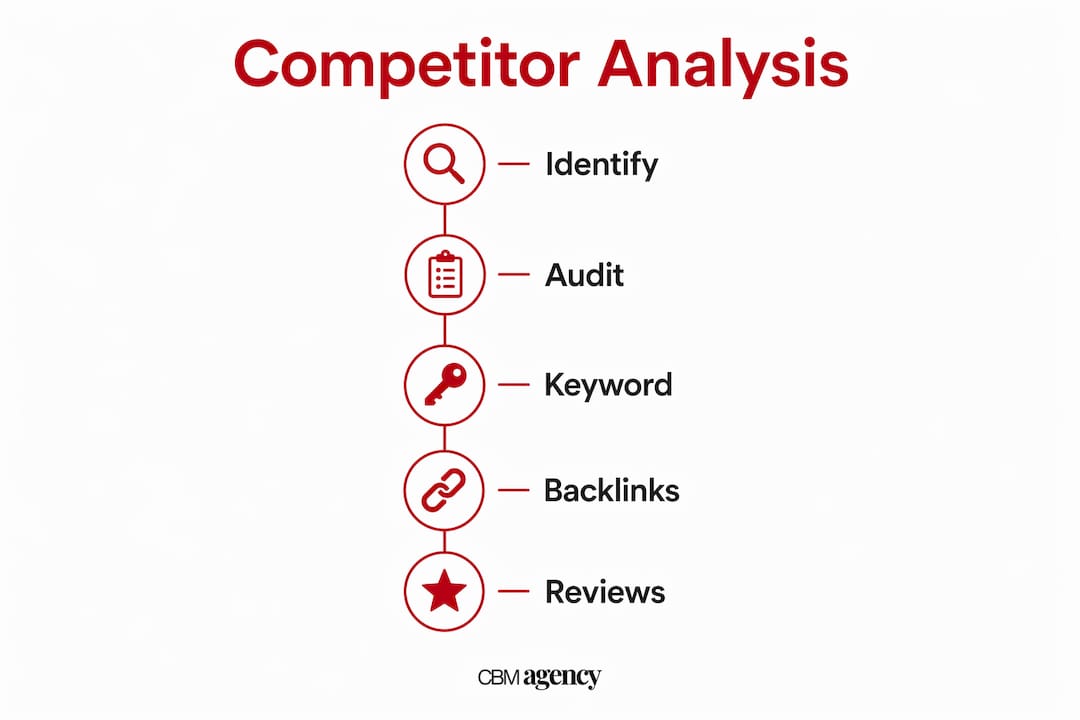
How to identify your true local SEO competitors
Your real local SEO competitors are not always the businesses you think of when you picture the competition. A company you compete with for airport runs may not even appear in the same Google local pack as you. The businesses that matter are the ones ranking on the first page for the exact searches your customers use.
Start with incognito Google searches using your most important service and location keywords. Search phrases like "limo service Miami airport" or "corporate car service downtown Chicago" and note every business appearing in the local pack and organic results. Cross-reference those domains across five to ten different keyword searches. The names that keep appearing are your real online rivals.
From there, use Semrush or Ahrefs to pull a full list of domains competing for the same organic keywords. These tools show you local pack competitors you would never spot manually. Once you have your list, sort competitors into three buckets:
- Direct competitors: Same service, same geographic area, targeting the same customer
- Indirect competitors: Different service type but competing for the same local search audience
- Aspirational competitors: Top performers in nearby markets or larger cities you want to emulate
This triage approach helps you decide where to invest effort. Defend your core local territory against direct rivals. Study aspirational competitors for tactics worth adopting. One critical mistake transportation SMBs make is wasting analysis time on national brands. Geographic segmentation matters because different ZIP codes trigger entirely different local packs. Focus your analysis on the specific neighborhoods and corridors where your customers actually book.
Pro Tip: Run your competitor searches from a mobile device in incognito mode. Mobile local packs often differ from desktop results, and most transportation bookings start on a phone.
How to audit competitors' Google Business Profiles
Google Business Profile (GBP) is the front door of local search for transportation companies. Auditing competitors' GBPs reveals exactly how they earn visibility in Google Maps and the local pack. This is where superior GBP optimization translates directly into more calls and bookings.
Work through this checklist for each competitor:
- Primary and secondary categories: Note every category they have selected. Transportation businesses often miss secondary categories like "Limousine Service," "Airport Shuttle Service," or "Car Service" that expand their search footprint.
- Business description: Read it carefully for keyword usage. Strong competitors weave in service types, city names, and customer outcomes naturally.
- Photo count and quality: Count their photos and assess whether they show vehicles, interiors, drivers, and service moments. More high-quality photos correlate with stronger Maps visibility.
- Post frequency: Check how often they publish Google Posts. Businesses posting weekly stay more visible than those who post once a month.
- Q&A section: Review the questions asked and whether the business answered them. Unanswered Q&As are a gap you can fill on your own profile.
- Review volume and recency: Note total reviews, average rating, and how recently reviews were posted.
Use BrightLocal or Whitespark to automate parts of this audit across multiple competitors at once. These tools surface GBP data at scale so you are not manually clicking through profiles for hours.
| GBP Signal | What to look for | Why it matters |
|---|---|---|
| Categories | Number and specificity | Broader category coverage increases search exposure |
| Photo count | Total images uploaded | Higher photo counts correlate with stronger Maps rankings |
| Review recency | Date of most recent reviews | Fresh reviews signal active business and build AI trust |
| Post frequency | Posts per month | Regular posting keeps the profile active in Google's eyes |
Consistent GBP activity and review responses map directly to better AI search recommendations. This means your GBP is not just a ranking tool. It is a trust signal for AI-powered results in ChatGPT, Perplexity, and Google's AI Overviews.

Pro Tip: Check competitors' GBP "From the owner" responses on reviews. The tone, speed, and consistency of those responses tell you how seriously they take reputation management.
What keyword gaps reveal about local search opportunities
Keyword gap analysis is the process of finding search terms your competitors rank for that your website does not. For transportation businesses, these gaps often represent specific routes, service types, or neighborhoods you are not targeting with dedicated content.
Follow this process:
- Pull your domain and two to three competitor domains into Semrush's Keyword Gap tool or Ahrefs' Content Gap report.
- Filter for keywords with local intent. Look for terms containing city names, neighborhood names, airport codes, or phrases like "near me."
- Prioritize keywords where competitors rank in positions one through ten and you rank outside the top fifty. These are your highest-value opportunities.
- Assess the SERP type for each keyword. If the results show a local pack, you need GBP optimization. If results show blog posts or service pages, you need content.
SMBs in transportation should build their analysis around ten to twenty money keywords with service and location modifiers. That focused list is more useful than chasing hundreds of generic terms.
Beyond keywords, study what content formats competitors use. Do they have neighborhood guides? Airport-specific landing pages? FAQ pages targeting common customer questions? Hyperlocal content tailored to specific areas creates differentiation that generic service pages cannot match. A page titled "Corporate Car Service from Brickell to Miami International Airport" targets a specific customer journey and faces far less competition than a generic "Miami car service" page.
| Content type | Competitor using it | Your current coverage |
|---|---|---|
| Airport-specific landing pages | Yes / No | Yes / No |
| Neighborhood service guides | Yes / No | Yes / No |
| Route-specific pages | Yes / No | Yes / No |
| FAQ and how-to content | Yes / No | Yes / No |
Use this table as a working template during your local market SEO comparison. Fill it in for each competitor and your own site to see exactly where content gaps exist.
How backlinks and citations build local authority
Backlinks and citations are the credibility layer of local SEO. A citation is any online mention of your business name, address, and phone number. A backlink is a direct link from another website to yours. Both signal to Google that your business is legitimate and locally relevant.
To analyze competitors' backlink profiles, run their domains through Ahrefs Site Explorer or Semrush's Backlink Analytics. Look for:
- Links from local news outlets, city blogs, and neighborhood publications
- Links from chambers of commerce, business associations, and local event sponsors
- Links from transportation industry directories and niche review platforms
- Guest posts or features on local lifestyle and business websites
Local and niche-relevant backlinks from local blogs, newspapers, and chambers of commerce carry more weight for local rankings than generic directory links. Every local link a competitor has that you do not is an outreach opportunity. Contact those same publications, associations, and blogs and pitch your business.
For citations, check whether competitors are listed consistently across Google Business Profile, Yelp, Apple Maps, Bing Places, and transportation-specific directories. NAP consistency across directories prevents Google from getting confused about which location data to trust. Use BrightLocal's Citation Tracker to compare your citation footprint against competitors and identify directories where you are missing.
Pro Tip: Your local chamber of commerce membership often includes a directory listing and a backlink. If a competitor has it and you do not, that is a quick win worth pursuing today.
Monitoring competitor reviews and reputation signals
Reviews are a direct local ranking factor and a trust signal for AI-powered search. Analyzing competitors' review profiles reveals where they are winning customer confidence and where they are leaving gaps you can fill.
When you evaluate a competitor's review presence, focus on these signals:
- Total review count: A competitor with 200 reviews and a 4.6 rating is harder to displace than one with 40 reviews and a 4.8 rating. Volume matters.
- Review recency: A business receiving reviews every week signals active operations. One whose last review was six months ago is vulnerable.
- Sentiment patterns: Read the negative reviews carefully. Recurring complaints about punctuality, communication, or vehicle quality are service gaps you can address and market against.
- Response rate and tone: Businesses that respond to every review, positive and negative, build stronger trust signals. Those that ignore reviews signal disengagement.
Responding to reviews regularly builds trust signals that matter for both traditional local rankings and AI recommendations. Set up Google Alerts and use a tool like BrightLocal to monitor competitor review activity automatically. When you spot a pattern of complaints in a competitor's reviews, that is your opportunity to position your service as the solution. For a deeper look at building your own review strategy, the guide on improving local reviews for transportation businesses covers the full process.
Key takeaways
Winning local SEO requires analyzing competitors across GBP signals, keyword gaps, backlinks, and review profiles as a coordinated, ongoing process rather than a one-time audit.
| Point | Details |
|---|---|
| Identify real competitors first | Use incognito searches and Semrush to find who actually ranks, not who you assume competes. |
| Audit GBP signals thoroughly | Compare categories, photo counts, post frequency, and review recency against top-ranking rivals. |
| Run keyword gap analysis | Find terms competitors rank for that you do not, then build targeted content to close those gaps. |
| Build backlinks from local sources | Prioritize links from chambers of commerce, local blogs, and niche directories over generic sites. |
| Monitor reviews continuously | Track competitor review volume, recency, and response rates to spot trust signal opportunities. |
What I have learned from doing this work in transportation
By Meshia
Most transportation business owners I work with have never looked at a competitor's Google Business Profile with any real intention. They glance at the star rating and move on. That is a missed opportunity every single time.
The businesses that consistently win in local search treat competitor analysis as a monthly habit, not a one-time project. They check what rivals are posting on GBP, which new reviews came in, and whether a competitor just launched a new service page targeting their best route. That kind of awareness lets you respond before you lose ground.
One thing I push back on is the obsession with national competitors or large fleet companies. If you run a mid-sized black car operation in a specific metro, a national brand's SEO strategy is largely irrelevant to your local pack performance. Your real competition is the three or four operators showing up in the same local pack for the same searches your customers use.
The other mistake I see constantly is treating this as a purely technical exercise. The coordinated local signals that drive rankings include your website, your GBP, and your reputation profile working together. Fix one and ignore the others and you will plateau. The transportation businesses that grow their local visibility fastest are the ones combining technical audits with consistent GBP activity and a real review generation strategy. That combination is harder to replicate than any single tactic.
— Meshia
How Cbmagencymiami helps transportation businesses outrank local competitors
Knowing what to look for in a competitor analysis is one thing. Executing it consistently while running a transportation business is another challenge entirely.
Cbmagencymiami specializes in local SEO and Google Business Profile optimization for transportation and service businesses. From auditing your competitors' GBP signals to building the content and citation strategy that closes ranking gaps, the team handles the work that turns competitor insights into real bookings. The Google Maps case study shows exactly what that looks like in practice for service businesses. If you are ready to build a local SEO strategy grounded in real competitive data, start with Cbmagencymiami's GBP optimization service built specifically for transportation companies.
FAQ
What tools are best for local SEO competitor analysis?
Semrush, Ahrefs, BrightLocal, and Whitespark are the most effective tools for analyzing local SEO competitors. They cover keyword gaps, backlink profiles, GBP data, and citation audits in one workflow.
How often should I analyze my local SEO competitors?
Run a full competitor audit quarterly and do a lighter monthly check on GBP activity and new reviews. Local rankings shift frequently, so ongoing monitoring is more effective than annual reviews.
Why do my competitors rank higher even with fewer reviews?
Review count is one signal among many. Competitors with stronger GBP optimization, more consistent posting, better citation coverage, and more local backlinks can outrank businesses with higher review counts.
What is NAP consistency and why does it matter?
NAP stands for Name, Address, and Phone number. Consistent NAP data across Google, Yelp, Apple Maps, and other directories tells Google your business information is accurate, which supports stronger local rankings.
How do I find hyperlocal content opportunities my competitors are missing?
Search for neighborhood names, local landmarks, and specific routes combined with your service type. If no competitor has a dedicated page for that combination, you have a content gap worth filling with a targeted landing page.