

Google ranking is the process by which individual web pages are evaluated and ordered in search results based on relevance, quality, and user experience. Understanding what is google ranking means understanding that Google scores each page separately, not your entire website. If you run a transportation company, a service business, or any operation that depends on local customers finding you first, your position in those results is the front door to your revenue. Google processes billions of queries daily using multi-layered systems that generate rankings in milliseconds. The businesses that win are the ones who understand how those systems work.
What is Google ranking and how does it actually work?
Google ranking is a page-level evaluation, not a site-wide score. Google looks at a specific page and asks: does this answer the query better than every other page competing for the same spot? To answer that, it runs your page through hundreds of ranking signals covering content relevance, technical performance, user experience, and authority.
The single most important thing to understand is that no one algorithm decides your rank. Google operates multiple independent ranking systems that each evaluate a different dimension of your page. Think of it as a panel of specialists rather than one judge. The Helpful Content system checks whether your content was written for people or for search engines. SpamBrain filters out manipulative tactics. The Page Experience system measures how fast and usable your page is on mobile. Each system contributes its verdict, and the combined result determines your position.
Two machine learning models play a particularly large role in modern ranking. RankEmbed maps queries and pages into an embedding space to measure semantic relevance beyond simple keyword matching. Navboost uses 13 months of user interaction data, segmented by location and device type, to adjust rankings based on how real users respond to results. That means your ranking is partly shaped by what people did after clicking your page months ago.
- Helpful Content system: Rewards pages written for people, not search engines
- SpamBrain: Detects and filters manipulative link schemes and thin content
- Page Experience: Evaluates Core Web Vitals, mobile usability, and HTTPS
- Reviews system: Assesses the quality and depth of product and service reviews
- RankEmbed: Measures semantic relevance using embedding models
- Navboost: Adjusts rankings using long-term user interaction signals
Pro Tip: Check Google Search Console's Core Web Vitals report before touching your content. A page that fails technical thresholds will not rank well regardless of how good the writing is.
Common misconceptions that hurt your Google ranking
The biggest myth in SEO is that older domains rank better. Domain age carries far less weight than content quality and user satisfaction. A new page on a newer domain can outrank a decade-old competitor if it answers the query more clearly and earns better engagement signals.
The second major mistake is fighting search intent. If someone searches "how much does airport car service cost," they want pricing information, not a booking form. Sending that traffic to a commercial landing page is called intent mismatch, and it is a primary reason businesses fail to convert traffic despite heavy SEO investment. Your page type must match what the searcher expects to find.
"Focusing on aligning content type precisely with search intent is the key to business SEO success, not chasing outdated ranking factor myths." — HubSpot Marketing Blog
Here are the misconceptions that cost businesses the most:
- Domain age decides rankings. Google evaluates the page, not how long the domain has existed.
- More backlinks always win. A handful of editorially earned links from relevant sources outperform hundreds of low-quality ones.
- Exact-match domains are a shortcut. Matching a keyword in your domain name provides minimal ranking benefit in 2026.
- One algorithm controls everything. Google runs parallel specialized systems, not a single formula.
- Ranking the homepage is enough. Individual service pages, blog posts, and location pages each rank independently.
The practical takeaway is this: Google evaluates the page in front of it. Build each page to answer one specific query better than anyone else, and you are already ahead of most competitors.
How to improve your Google ranking in 2026
Improving your position in search results follows a clear sequence. Start with the technical floor, then build content quality, then earn authority.
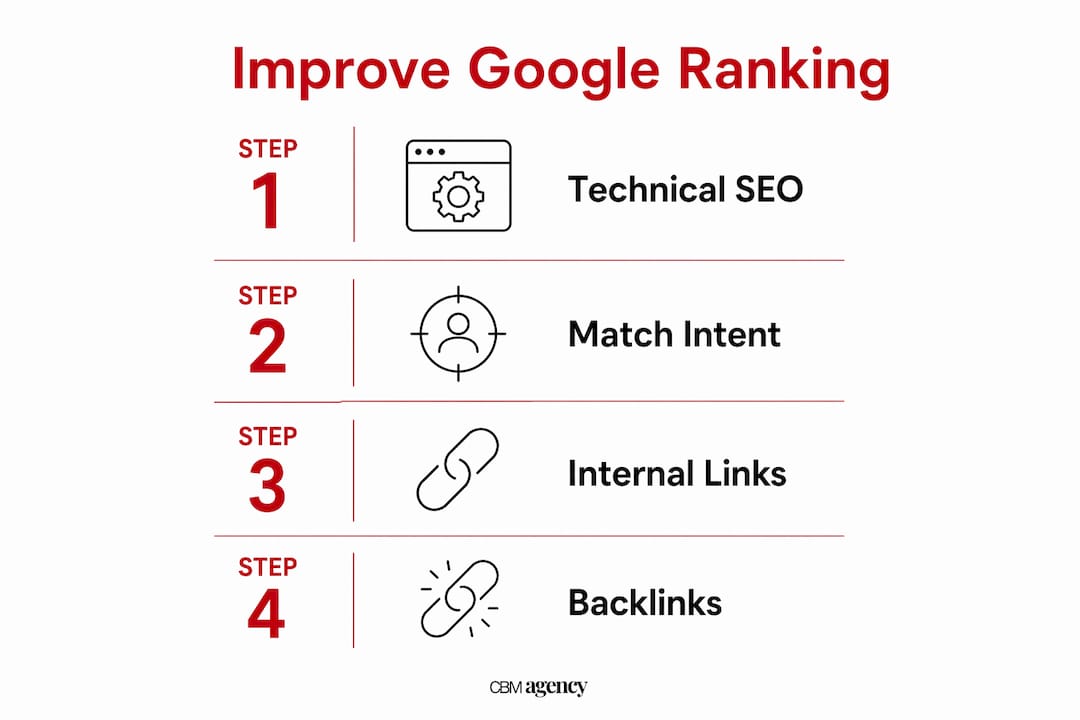
Step 1: Meet the technical thresholds first
Technical SEO basics like Core Web Vitals, mobile responsiveness, and HTTPS are prerequisites, not bonuses. Neglecting them makes high-quality content invisible to ranking systems. Use Google's PageSpeed Insights and Search Console to identify and fix these issues before anything else.
Step 2: Create content that matches search intent
Every page needs a clear purpose tied to one query type. Informational queries need explanatory content. Commercial queries need clear service descriptions, pricing signals, and trust indicators. Search intent alignment is the single factor that separates pages that rank from pages that stall.

Step 3: Build internal links from informational to commercial pages
Internal linking transfers authority from your high-traffic blog posts and guides to your revenue-generating service pages. Use descriptive anchor text that tells Google what the destination page is about. A transportation company that links from a "how to book airport transfers" guide to its booking page passes real ranking value to the page that makes money.
Pro Tip: Audit your top 10 most-visited pages in Google Analytics. Add at least one internal link from each of those pages to your most important commercial page using descriptive anchor text.
Step 4: Earn authoritative backlinks
External backlinks remain among the strongest ranking factors in 2026. The focus must be on quality and editorial context, not volume. One link from a relevant logistics publication or a local business directory carries more weight than 50 links from unrelated sites. For transportation businesses, on-page SEO strategies combined with targeted outreach produce the best results.
| Factor | Low impact approach | High impact approach |
|---|---|---|
| Content | Keyword-stuffed pages | Intent-matched, people-first content |
| Backlinks | High volume, low relevance | Few links, high editorial relevance |
| Technical SEO | Ignored until rankings drop | Fixed before content work begins |
| Internal linking | Random or absent | Structured flow from info to commercial pages |
| User experience | Desktop-only focus | Mobile-first, fast-loading pages |
How Google's ranking systems keep evolving
Google's ranking systems do not stay static. Core updates are broad recalibrations that shift how Google weighs quality signals globally. They do not target individual tactics or keywords. When a core update rolls out, pages that genuinely serve users tend to hold or gain positions, while pages built around manipulation tend to drop.
SpamBrain and the Helpful Content system adapt continuously. They are not one-time filters. Google trains these models on new data regularly, which means a tactic that worked in 2023 may actively hurt you in 2026. The businesses that maintain strong rankings treat SEO as an ongoing practice, not a one-time project.
Navboost collects user interaction data over 13 months, including clicks, dwell time, and query refinements. This means your ranking today reflects how users responded to your page over the past year. A page that consistently earns clicks and holds attention builds a positive signal history. A page that earns clicks but sends users back to Google immediately sends a negative one.
Key behaviors that affect your ranking over time:
- Click-through rate: A low CTR on a high-impression page signals a weak title or meta description
- Dwell time: Users who stay on your page tell Navboost the content delivered value
- Pogo-sticking: Users who return to search results immediately signal a mismatch between the page and the query
- Query refinements: When users search again after visiting your page, it signals the content did not fully satisfy the intent
For businesses in the transportation and logistics sector, understanding how these behavioral signals accumulate is the difference between a page that climbs and one that stalls despite good content.
Key Takeaways
Google ranking is a page-level evaluation driven by hundreds of signals across multiple independent systems, and businesses that align technical SEO, content quality, and user experience simultaneously are the ones that consistently rank well.
| Point | Details |
|---|---|
| Page-level evaluation | Google ranks individual pages, not entire websites, for each specific query. |
| Multiple ranking systems | Helpful Content, SpamBrain, and Page Experience each assess different quality dimensions independently. |
| Technical thresholds first | Core Web Vitals and mobile responsiveness must be met before content or backlinks affect rankings. |
| Intent alignment wins | Matching your page type to the searcher's intent is the most direct path to ranking improvement. |
| Internal linking drives authority | Linking from informational pages to commercial pages transfers ranking value to revenue-generating content. |
Why most businesses are solving the wrong ranking problem
Working with transportation and service businesses on Google visibility, I see the same mistake repeatedly. Owners spend months chasing backlinks or rewriting meta descriptions while their pages fail basic Core Web Vitals tests. The technical floor is not optional. It is the entry fee.
The second pattern I see is treating Google as one algorithm to outsmart. It is not. It is closer to a panel of specialists, each with their own criteria. You cannot game the Helpful Content system with keyword density while ignoring the Page Experience system's mobile requirements. Both matter, and they operate independently. A page that passes one and fails another will not reach its potential.
What actually works is building pages that serve a specific person with a specific question. A chauffeur company that writes a detailed guide on what to expect during airport pickup, links that guide to its booking page, and loads that booking page in under two seconds is doing everything right. The Google Maps ranking factors for local service businesses follow the same logic: relevance, proximity, and trust signals all feed into the same underlying principle.
Stop chasing the algorithm. Start building pages that deserve to rank.
— Meshia
Ready to turn your Google visibility into real bookings?
Understanding how Google ranks pages is the first step. Putting that knowledge to work is where most businesses need a partner. Cbmagencymiami helps transportation and service businesses build a stronger presence in Google search and local results, so more searches turn into calls and confirmed bookings.
If your Google Business Profile is incomplete, inconsistent, or simply not showing up for the searches that matter, that is lost revenue every day. Cbmagencymiami's Google Business Profile optimization service covers everything from category selection and service descriptions to photo optimization and review management. See how the same approach has delivered results for service businesses in the Google Maps case study. If you want more searches to become bookings, the profile is where it starts.
FAQ
What is Google ranking in simple terms?
Google ranking is the position your web page holds in search results for a specific query. Google evaluates individual pages using hundreds of signals and places the most relevant, high-quality results at the top.
How many ranking factors does Google use?
Google uses over 100 ranking signals at the top level, including content relevance, backlinks, Core Web Vitals, mobile usability, and user interaction data collected over time.
Does domain age affect Google ranking?
Domain age has minimal impact on ranking. Google evaluates the quality and relevance of individual pages, and a new page with strong content and good user experience can outrank older domains.
How long does it take to improve Google ranking?
Ranking improvements typically take weeks to months depending on competition, the current state of your technical SEO, and how quickly Google recrawls your pages. Technical fixes tend to show results faster than content or link-building efforts.
What is the fastest way to increase search engine ranking?
Fix technical SEO issues first, particularly Core Web Vitals and mobile responsiveness. Then align your page content with the exact intent of the query you are targeting. These two steps produce the most direct ranking gains in the shortest time.